Regulation Is Not the Same as Calm: How to Notice Dysregulation Before It Takes Over
Most advice about emotional regulation begins too late.
It tells us what to do when we are already furious, panicking, crying, shutting down or saying something we are likely to regret. Take a deep breath. Count to ten. Go for a walk. Think before you speak.
There is nothing inherently wrong with those suggestions. The difficulty is that, once our system is highly activated or overwhelmed, remembering and using them can be surprisingly hard. By that point, our thoughts may feel urgent, our attention may have narrowed and our usual capacity for perspective may be temporarily unavailable.
The earlier—and often more difficult—part of regulation is learning to notice what happens before we reach that point.
Dysregulation is not only a neurodivergent experience
Emotional and nervous-system regulation is frequently discussed in relation to ADHD and autism, and for good reason. Neurodivergent people may experience particular regulation challenges connected with sensory input, emotional intensity, transitions, executive demands or the effort involved in navigating environments that are not designed for them. Emotional dysregulation is commonly reported in adults with ADHD, while sensory and emotion-regulation differences are also recognised within autism research.
However, dysregulation is not something that belongs exclusively to neurodivergent people.
Everyone has a body that responds to stress, conflict, uncertainty, tiredness, hunger, pain, overstimulation and accumulated demands. Anyone can become too activated, too overwhelmed or too depleted to respond in the way they would prefer.
The circumstances, frequency and intensity may differ, but the underlying skill of noticing and responding to our own state can benefit all of us.
It can help us understand ourselves more accurately, communicate our needs more clearly and reduce the likelihood that temporary distress will make decisions on our behalf.
What does dysregulation actually feel like?
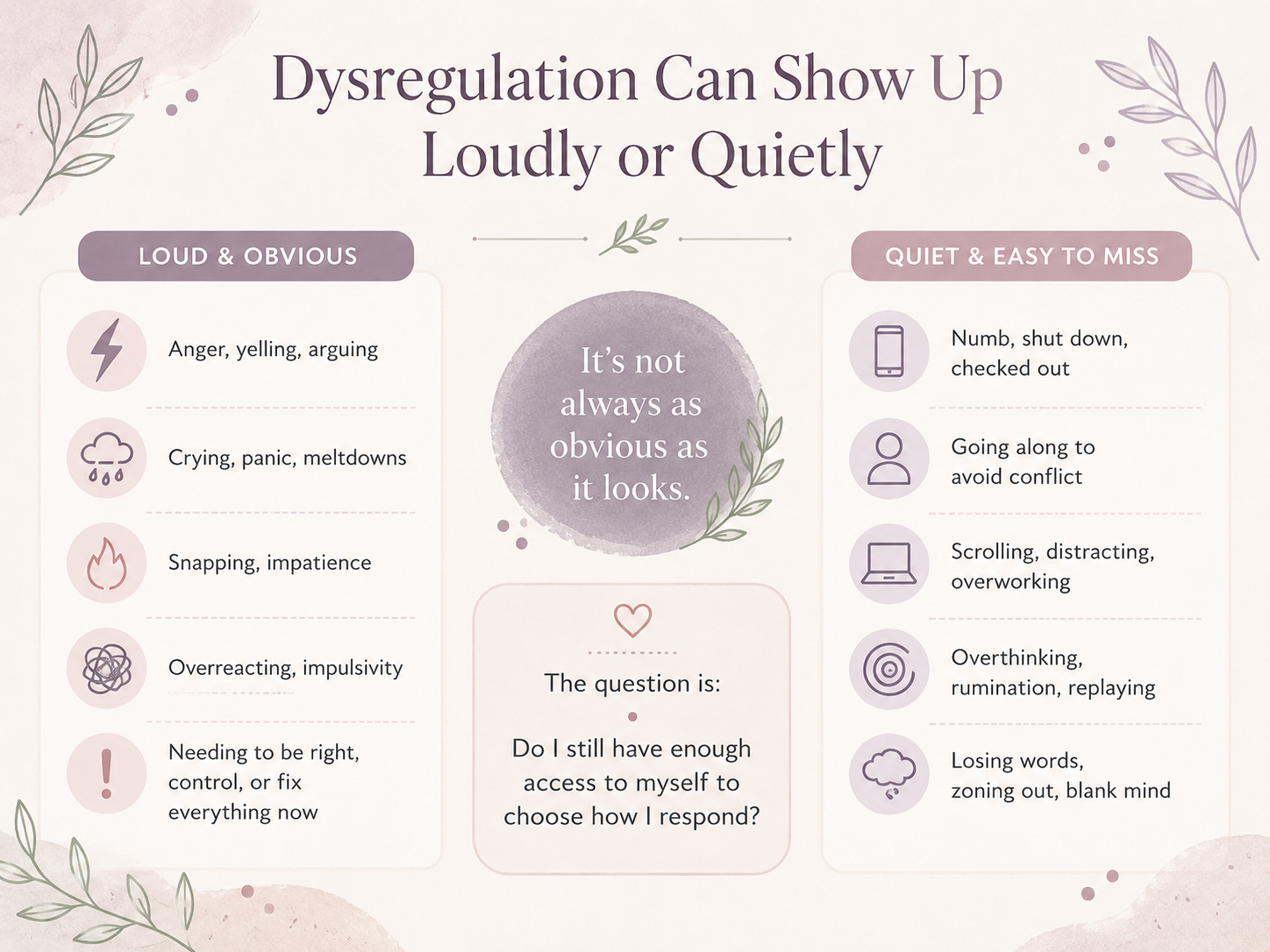
Many people imagine dysregulation as something obvious: shouting, crying, panic, rage or a visible meltdown. Sometimes it is.
At other times, it is quiet enough to be mistaken for productivity, logic, politeness or tiredness.
Dysregulation might look or feel like:
talking faster, louder or more forcefully than usual;
becoming unusually rigid about how something must be done;
interrupting, overexplaining or repeatedly trying to prove your point;
feeling an urgent need to resolve a problem immediately;
becoming intensely focused on one detail while losing sight of the larger conversation;
suddenly finding ordinary sounds, questions or physical contact irritating;
agreeing with someone simply to make the interaction end;
losing access to words or being unable to explain what is wrong;
going blank, numb or distant;
withdrawing without being able to say why;
scrolling, eating, cleaning, shopping or working compulsively;
feeling restless while being unable to begin anything;
replaying an interaction and mentally preparing arguments;
interpreting neutral comments as criticism or rejection;
feeling as though everyone needs something from you;
wanting to escape, hide, fix, fight, apologise or shut everything down.
This does not mean that every uncomfortable feeling is dysregulation. Anger, grief, frustration, and fear are not problems that must be removed automatically. They often carry important information.
The more useful question is:
Do I still have enough access to myself to choose how I respond?
Regulation does not mean making yourself calm
We can sometimes treat regulation as a demand to become quiet, pleasant and easy for other people to deal with.
That is not the goal.
Regulation is not emotional suppression. It does not require pretending that something is acceptable when it is not. It does not mean breathing through mistreatment, tolerating an unsafe situation or making ourselves smaller so that someone else remains comfortable.
Regulation means creating enough internal space to decide what happens next.
You may regulate and still decide to leave.
You may regulate and still say no.
You may regulate and still be angry, disappointed or unwilling to continue a conversation.
The difference is that the response becomes more deliberate and less controlled by the immediate surge of the moment.
Research on regulatory flexibility also suggests that no single strategy is helpful in every circumstance. Effective regulation involves noticing the context, having more than one possible response and adjusting when a strategy is not helping.
In other words, the aim is not to find the perfect calming technique. It is to build a flexible collection of ways to support yourself.
The first skill is noticing—not fixing
When people begin paying attention to dysregulation, they often say:
“I did not realise what was happening until it was too late.”
That is not a failure. It is usually the starting point.
You might initially recognise dysregulation only after an argument, a shutdown or an exhausting day. With practice, you may begin to notice it during the event. Later, you might recognise the earlier signals: your jaw tightening, your speech speeding up, your shoulders rising or your patience becoming noticeably thinner.
Progress does not necessarily mean that you never become dysregulated.
It may mean noticing at an intensity of 8 out of 10 instead of 10.
Then perhaps 6 out of 10.
It may mean pausing before sending the message rather than regretting it afterwards. It may mean repairing a conversation sooner. It may mean recognising that you need food, quiet or rest before deciding that everybody in your life is unbearable.
Learning to detect internal bodily signals is sometimes called interoceptive awareness. Research links this awareness to emotional experience and regulation, although people differ considerably in how clearly or comfortably they notice sensations within their bodies.
For some people—particularly those living with trauma, panic, chronic pain or certain health conditions—focusing closely on internal sensations can feel distressing rather than helpful. In that case, beginning with the external environment may be more accessible. You do not have to force yourself to scan your body in order to regulate.
A brief B.A.S.E. check
Rather than asking yourself to identify the precise emotion immediately, try checking four areas:
B — Body
What has changed physically?
Notice your jaw, shoulders, chest, stomach, hands, breathing, temperature and muscle tension. You are not searching for the “correct” sensation. You are looking for what is different from your usual state.
A — Attention
What is your attention doing?
Has it become scattered, foggy or fixed on one threat? Are you repeatedly rereading a message, watching someone’s facial expression or searching for evidence that something is wrong?
S — Speed
Has your internal or external pace changed?
You might be speaking, typing, walking or thinking more quickly. Alternatively, everything may have slowed down and become difficult to access.
E — Escape or engagement urge
What does your system want you to do?
Argue? Fix everything? Leave? Hide? Apologise? Please the other person? Stop speaking? Demand an answer? Reach for your phone?
The urge is information, not an instruction.
The B.A.S.E. check is not intended to diagnose your state. It simply helps you notice that something has shifted before deciding what support might fit the situation.
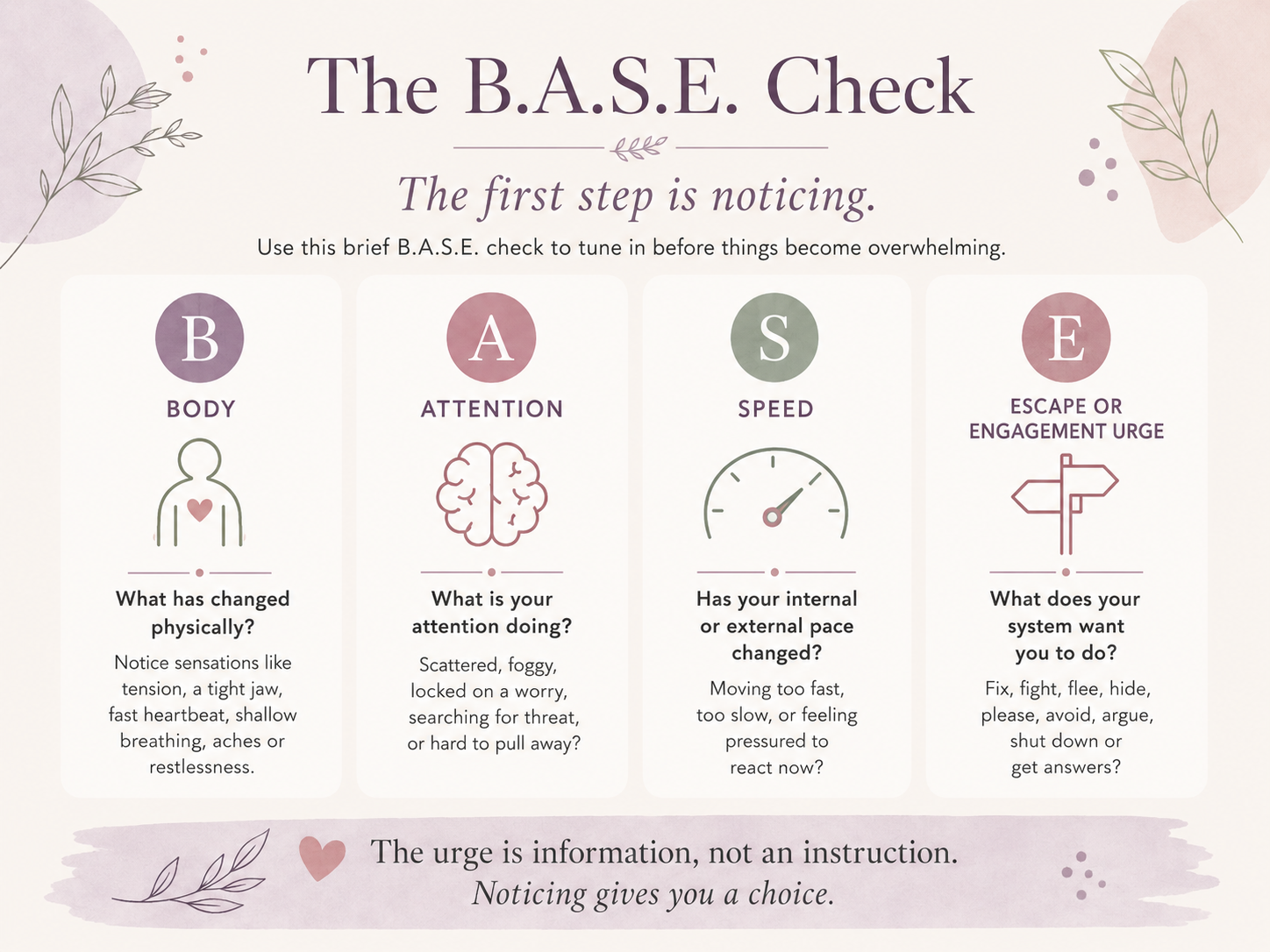
Use B.A.S.E to begin to notice your dysregulation
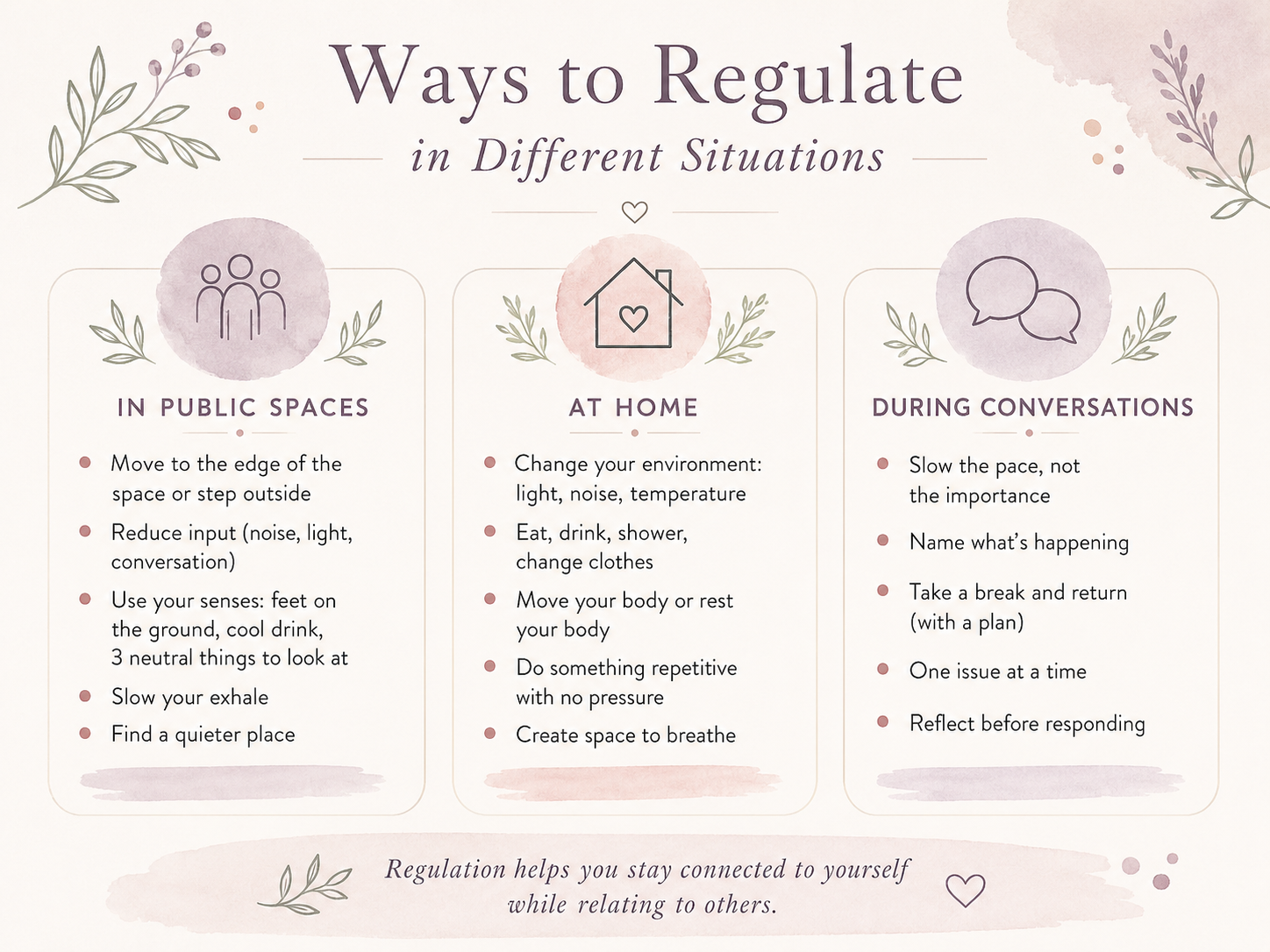
Regulating in a public space
Public regulation often needs to be small, discreet and realistic. You may not be able to lie down, turn off the lights or leave immediately.
Try reducing the amount of information your system has to process.
You might:
move towards the edge of the room rather than remaining in the centre;
step outside or visit the bathroom for a brief sensory break;
reduce conversation and stop trying to appear socially “fine”;
place both feet firmly on the ground and notice the pressure beneath them;
identify three neutral objects around you without evaluating them;
hold a cool drink or run cool water over your hands;
loosen restrictive clothing where possible;
use earplugs, headphones, sunglasses or another sensory support;
focus on making your exhale slightly slower rather than forcing a large breath;
give yourself one clear instruction, such as, “Find somewhere quieter.”
Slow and exhale-focused breathing practices can help some people reduce arousal and improve mood, but breathing exercises are not universally comfortable or effective. If focusing on your breath increases panic, dizziness or self-consciousness, choose an external strategy instead.
The goal in public is not necessarily to feel completely settled. It may simply be to prevent further escalation until you can access more space and support.
Regulating at home
At home, we often make the mistake of trying to think our way out of a state that has been shaped by physical and sensory demands.
Before analysing the entire day, consider changing the immediate conditions.
Ask:
Do I need food or water?
Is the room too bright, noisy, hot or crowded?
Am I still wearing uncomfortable work clothes?
Have I moved my body today?
Have I had any time without conversation, decisions or incoming information?
Am I trying to complete one more task because stopping feels uncomfortable?
Helpful actions might include changing clothes, dimming the lights, eating something substantial, having a shower, stretching, walking, sitting somewhere quieter or completing a repetitive activity with no performance expectation.
For some people, movement is regulating. For others, stillness is. Some need music; others need silence. Some need company without conversation. Others need to be completely alone.
Your strategy does not have to look therapeutic. It only needs to help your system move towards greater choice.
Regulating during a conversation
Regulation becomes more complicated when another person is involved because both people’s states can influence the interaction. Research describes co-regulation as a mutual process in which people respond and adapt to one another; interactions can sometimes help distress settle, but they can also amplify it.
When you notice yourself becoming dysregulated during a conversation, the immediate goal may be to slow the interaction rather than solve the issue.
Possible phrases include:
“I want to keep talking about this, but I am becoming overwhelmed and I do not think I am communicating well.”
“I need ten minutes to settle. I will come back at 7.30 so we can continue.”
“I can feel myself becoming defensive. Could we slow this down and deal with one part at a time?”
“I am not ignoring you. I am struggling to find words at the moment.”
“I need a little more physical space while we talk.”
A pause is usually more reassuring when it includes a clear intention to return. Without that reassurance, one person may experience the break as abandonment while the other experiences continued conversation as pressure.
During the conversation, it may also help to:
lower the speed rather than the emotional importance of what you are saying;
discuss one issue instead of introducing every related frustration;
sit beside one another rather than directly opposite;
reduce forced eye contact;
avoid demanding an immediate explanation from someone who has lost access to words;
check whether touch would be supportive rather than assuming;
reflect what you heard before preparing your response;
postpone major decisions until both people have greater capacity.
Regulation does not guarantee agreement. It simply makes genuine communication more possible.
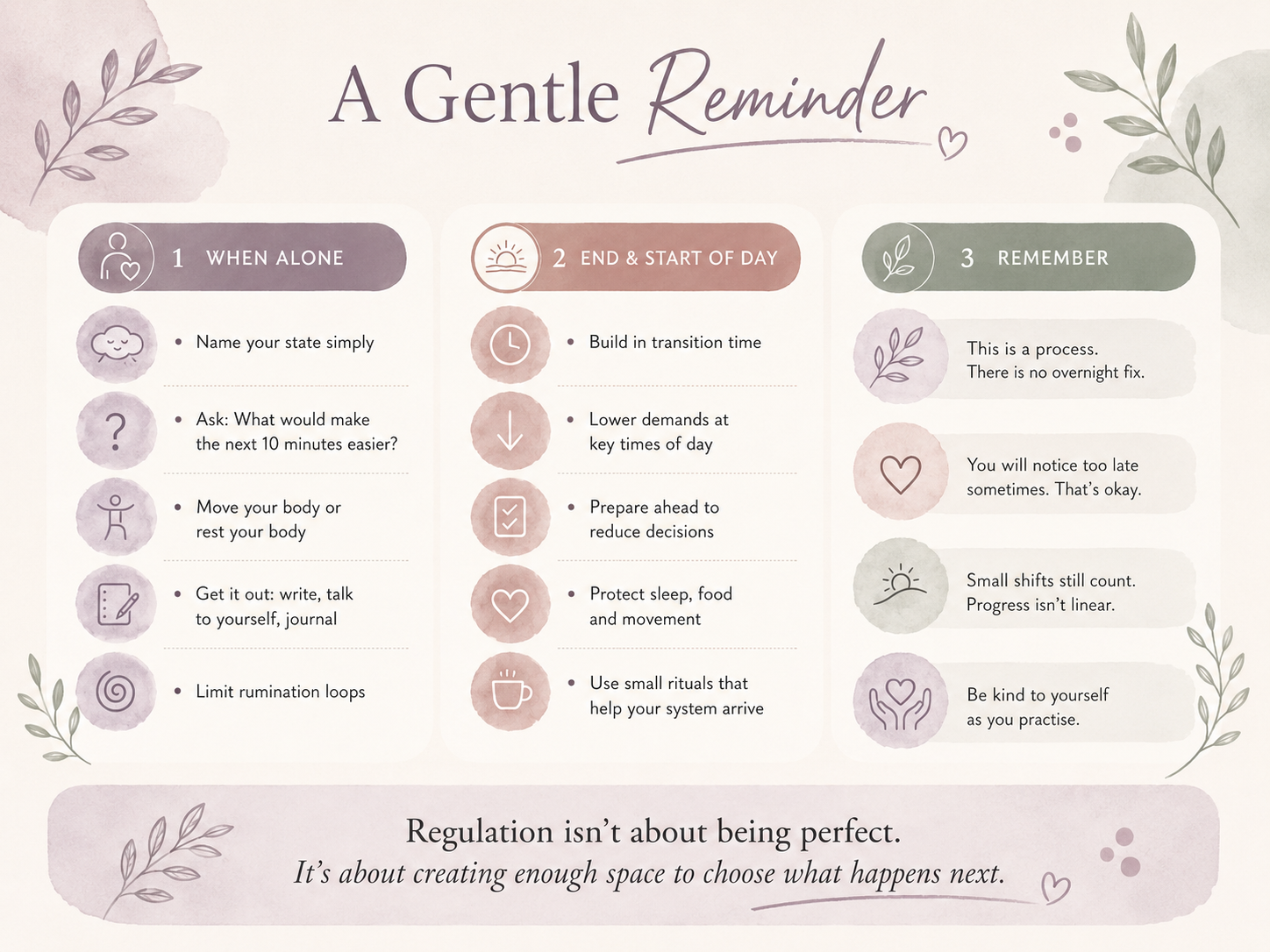
Regulating when you are alone
Being alone does not automatically mean that your system will settle.
Without another person present, you may continue an argument internally, rehearse possible disasters or become trapped in scrolling and rumination.
Try describing your state before trying to explain its entire cause:
“I am highly activated.”
“I feel overloaded.”
“My thoughts are moving very quickly.”
“I feel shut down.”
“I am searching for certainty.”
“I have a strong urge to fix this immediately.”
You do not need to find the perfect emotional label. Sometimes a broad description creates enough distance to choose the next step.
You might then ask:
What would make the next ten minutes slightly easier?
Not the whole week. Not the relationship. Not your entire life.
The next ten minutes.
When dysregulation appears at the end of the day
Some people manage effectively through work, study, parenting or social demands, only to become irritable, tearful, restless or withdrawn when they arrive home.
This does not necessarily mean that home is the problem. It may be the first place where the effort of holding everything together is no longer required.
A transition period can help prevent accumulated strain from spilling directly into the next interaction.
That might mean:
ten minutes without questions after arriving home;
eating before discussing practical problems;
changing clothes immediately;
sitting in the car briefly without using your phone;
walking around the block;
lowering household noise;
using a predictable transition playlist;
letting others know, “I am pleased to see you, but I need a short reset before I can talk properly.”
This is not a rejection of the people around you. It is preparation for being more genuinely available to them.
When dysregulation appears at the start of the day
For others, the difficulty begins in the morning.
You may wake already anticipating demands, conversations, travel, unfinished tasks or uncertainty. If this is a regular pattern, consider whether your morning is asking for too many decisions before your system has properly arrived.
A lower-friction morning might include:
preparing clothes, food or work materials the night before;
delaying emails, news and social media;
using softer lighting;
keeping the order of tasks predictable;
allowing more time between waking and interacting;
eating and drinking before beginning complex work;
including brief movement;
writing down the first three tasks instead of mentally carrying the entire day.
The aim is not to create a perfect morning routine. It is to remove unnecessary demands from a time when your capacity is predictably lower.
Sometimes the answer is not another regulation exercise
Regulation strategies are useful, but they should not become another way of placing all responsibility on the individual.
Sometimes you are dysregulated because you are being treated poorly.
Sometimes your environment is continually overwhelming.
Sometimes your workload is unreasonable, your boundaries are being ignored, or you have been operating without enough rest, food, privacy, safety or support.
In those situations, the most regulating action may not be a breathing exercise.
It may be setting a boundary, leaving the room, cancelling something, asking for help, eating, sleeping, changing the environment or acknowledging that the current arrangement is not sustainable.
Skills can help us respond to difficult conditions. They should not be used to convince us that we must peacefully tolerate those conditions forever.
Persistent or severe changes in regulation can also be affected by trauma, anxiety, depression, chronic stress, pain, sleep disruption, illness, hormonal changes, medication and other physical or psychological factors. Support from a GP or qualified mental health professional may be appropriate when dysregulation is frequent, worsening or significantly affecting daily life and relationships.
How regulation changes relationships
Learning to recognise your own state is personal work, but its effects are relational.
It can help you:
explain what is happening before disappearing or exploding;
distinguish between needing space and wanting to end the relationship;
make a specific request instead of expecting someone to guess;
hear another person’s meaning rather than only detecting threat;
avoid treating urgency as proof that something must be resolved immediately;
recognise when both people need a pause;
repair more quickly after a difficult interaction;
take responsibility without shaming yourself;
understand that another person’s need for regulation is not necessarily rejection.
We cannot control another person’s nervous system, and we should not be expected to regulate everyone around us. However, we can become more aware of what we bring into an interaction and more intentional about how we communicate when our capacity is reduced.
Be gentle with the process
You will not learn your regulation patterns overnight.
There will be times when you notice too late. There will be strategies that work one day and irritate you the next. There will be moments when you understand exactly what is happening and still cannot respond perfectly.
That does not mean the work is failing.
Noticing afterwards is still noticing.
Repairing later is still repair.
Realising that you were hungry, frightened, overstimulated or exhausted does not excuse harmful behaviour, but it gives you useful information about how to respond differently next time.
The goal is not to become permanently calm, endlessly patient or unaffected by life.
The goal is to become more self-reachable—to recognise when your choices are narrowing and to offer your system enough support to find some of them again.
That is a skill. It is also a practice.
And, like most meaningful practices, it is built gradually, imperfectly and with compassion.
This article provides general information and is not a substitute for individual medical or mental health advice. If emotional distress or dysregulation is significantly affecting your safety, relationships or daily functioning, consider seeking support from an appropriately qualified professional.