Seeking Counselling as a Sex Worker: What Affirming Support Can Look Like
Seeking counselling as a sex worker can come with understandable concerns about judgement, privacy and being reduced to your work. This article explores what genuinely affirming support can look like, the questions you are entitled to ask, and how counselling can make room for your whole life—not just assumptions about your job.
Seeking counselling can feel vulnerable for anyone.
For sex workers, there may be an additional layer of questions:
Will I be judged? Will everything be blamed on my work? Will I be asked intrusive questions? Will I have to educate the counsellor before they can support me?
Those concerns are understandable. Australian research involving 647 sex workers found that 96% had experienced sex-work-related stigma or discrimination during the previous year, while 91% reported some form of negative treatment from health workers. Research also consistently identifies stigma, discrimination and mistrust of services as barriers to accessing mental health and other healthcare. (Scarlet Alliance)
Sex-worker-affirming counselling aims to offer something different.
It is not about assuming that sex work is always positive, always harmful or necessarily the reason someone has come to counselling. It is about meeting the person in front of the counsellor with respect, curiosity and room for their own experience.
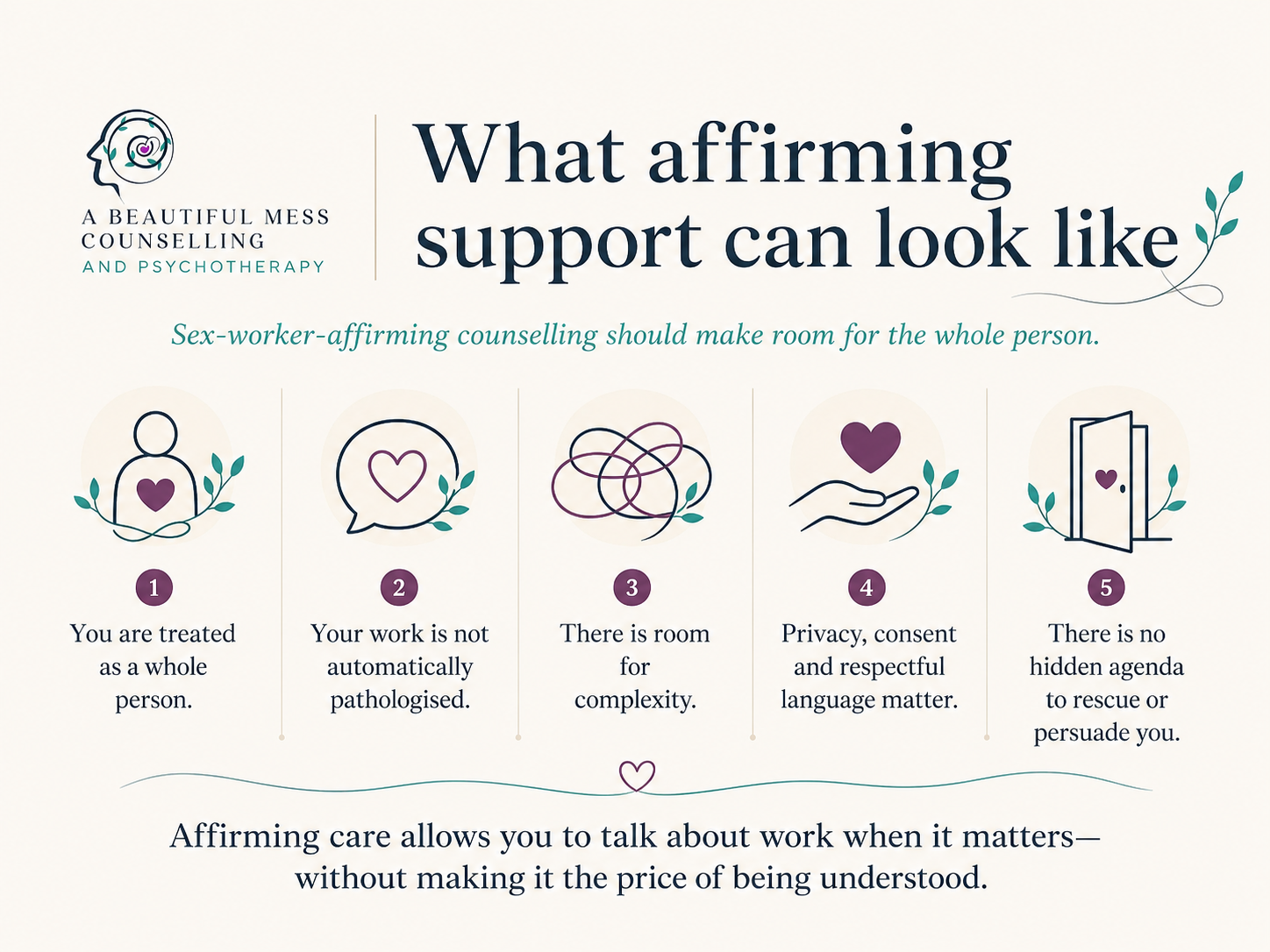
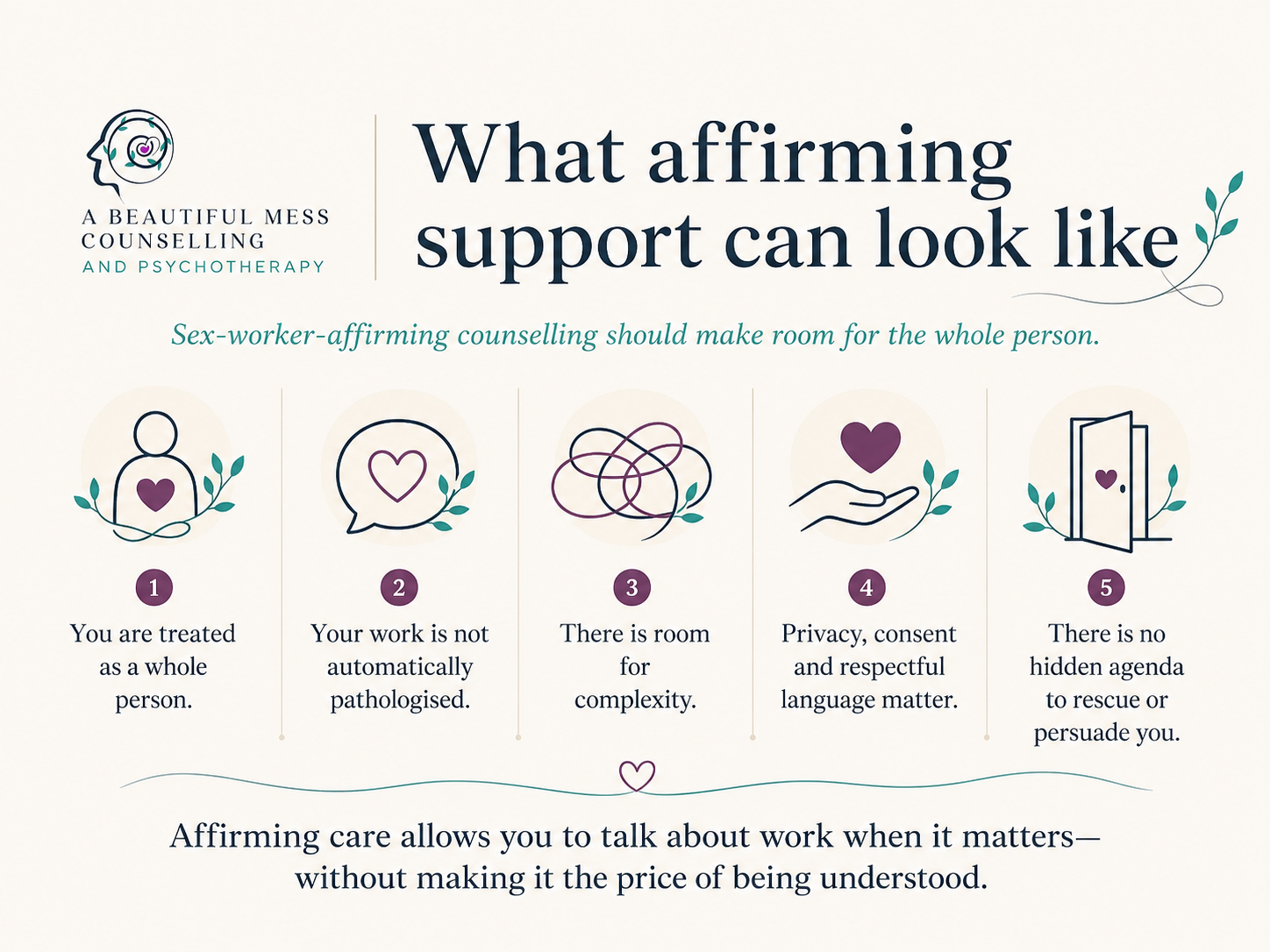
You are treated as a whole person
You may be seeking counselling because of anxiety, grief, burnout, neurodivergence, identity, relationships, family difficulties or something entirely unrelated to work.
An affirming counsellor does not automatically centre sex work simply because you have disclosed it.
They may ask whether your work is relevant to what you are experiencing. They should also be able to hear that it is not the focus and move on.
You should not have to become a case study about sex work before receiving support for the rest of your life.
Your work is not automatically pathologised
Research increasingly emphasises that sex workers’ wellbeing is shaped by a wide range of structural and personal circumstances, including stigma, discrimination, violence, financial conditions, legal environments, access to services, relationships and social support. Sex work itself should not be treated as a diagnosis or a complete explanation for someone’s mental health.
An affirming counsellor does not begin with assumptions such as:
sex work must be caused by trauma;
remaining in the industry means you lack insight or self-worth;
enjoying aspects of the work means difficult experiences cannot affect you;
wanting to leave means the work was necessarily damaging;
every boundary, relationship or sexual concern must be connected to your job.
Instead, they ask what the work means to you.
There is room for complexity
Your experience of sex work may be positive, practical, empowering, tiring, stressful, complicated—or different from one day to the next.
You may value the income, autonomy, flexibility, creativity or community while also struggling with stigma, difficult clients, emotional labour or burnout.
You may want to remain in the industry, change the way you work, take a break or leave altogether.
Affirming counselling does not require you to present sex work as entirely good or entirely harmful. There should be room to speak honestly without worrying that one difficult experience will be used to invalidate your choices—or that you must defend the industry before discussing something that hurt.
Questions have a purpose
Counselling often involves questions, but there is a difference between useful curiosity and voyeurism.
A counsellor may need to understand how something affects your safety, relationships, work or wellbeing. They do not need unrestricted access to intimate details simply because your work involves sexuality.
It is reasonable to ask:
“How is that information relevant to what we are working on?”
You can also say:
“I can explain the impact without describing the details.”
“I do not want my work to be the focus today.”
“I am not comfortable answering that question.”
A respectful counsellor will not punish your boundaries or treat reluctance to disclose as evidence that something is wrong.
Privacy is taken seriously
Disclosure can have consequences beyond the counselling room. A person may have concerns about family, housing, employment, banking, parenting, migration or simply being outed without their consent.
Your counsellor should clearly explain confidentiality, its limits, how records are kept and when information could be shared. They should use respectful language and record only what is clinically relevant.
You can ask before disclosing:
Will my occupation appear on invoices or correspondence?
Who can access my clinical notes?
What information would be included in a referral or report?
Will you ask my permission before contacting another service?
What are the legal and ethical limits of confidentiality?
You do not have to disclose your sex-worker status immediately—or at all—unless you decide it is relevant and feel comfortable doing so.
There is no hidden rescue agenda
Affirming counselling is not secretly organised around persuading you to leave sex work.
It also does not ignore coercion, violence, unsafe conditions or work you no longer want to do.
Taking someone’s autonomy seriously means being able to explore both choice and constraint without deciding the conclusion in advance.
The counsellor’s role is to help you understand what you want, consider your options, strengthen safety and support your goals—not substitute their values for your own.
The counsellor takes responsibility for learning
You may occasionally need to explain something specific about your experience. You should not have to provide an introductory course in sex work before meaningful counselling can begin.
An affirming counsellor recognises gaps in their knowledge, seeks appropriate professional development and supervision, and learns from sex-worker-led organisations and resources.
Australian peer-led resources such as Scarlet Alliance’s Red Book Online are developed by sex workers for sex workers and can also help professionals locate sex-worker-friendly services and understand community language, health needs and harm-reduction approaches.
Questions you might ask a counsellor
Before booking—or during an initial conversation—you might ask:
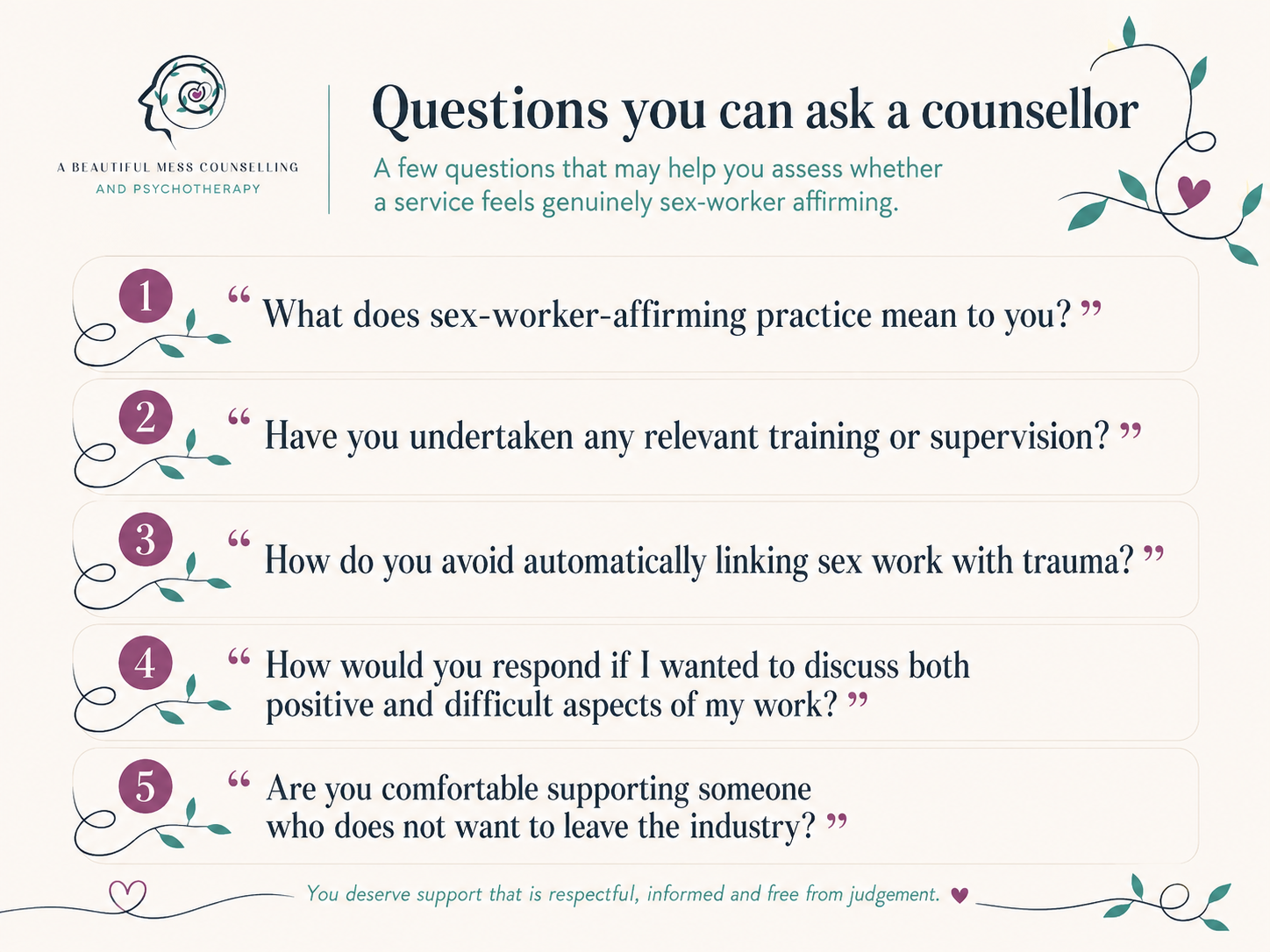
There is no perfect scripted answer. Listen for openness, respect and an ability to respond without becoming defensive, sensationalising your work or rushing to reassure you with vague claims of being “non-judgemental”.
You deserve support without having to defend your dignity
Affirming counselling does not mean that every session will be comfortable or that difficult subjects will never arise.
It means those conversations happen with consent, purpose and respect.
You should be able to talk about sex work when it matters—and leave it outside the conversation when it does not.
You should be able to explore pride, stress, pleasure, grief, boundaries, relationships, safety, ambition or uncertainty without being reduced to a stereotype.
Most importantly, you should be able to arrive as a whole person.
Not as a problem to solve, a story to analyse or an industry you are expected to defend.