Why Do I Need Reassurance From My Partner — and Why Can Asking Feel So Vulnerable?
There are moments in relationships when many of us want some reassurance from the person we love — or simply want an answer to a question that has started circling in our mind:
Are we okay?
Do you still want me?
Are you upset with me?
Did I misunderstand what happened?
Do I still matter to you?
Sometimes we know exactly what we want to ask. Other times, we just have that uncomfortable sense that something feels uncertain and we want our partner to help settle it.
And yet asking for reassurance can feel surprisingly vulnerable.
We might worry that we are being “needy”, demanding too much, or putting pressure on our partner. Sometimes we do not ask directly at all. Instead, we circle around the question, look for clues in their tone or behaviour, withdraw to see whether they notice, or ask for reassurance without quite knowing what reassurance we actually need.
The need itself, though, is not necessarily a problem.
Humans are relational. Feeling understood, cared for and responded to by people who matter to us is an important part of close relationships. Research into intimate relationships has repeatedly found that feeling that our partner understands us, cares about us and responds to what matters to us is an important part of connection.
Sometimes reassurance is simply one way of reaching for that connection.
Sometimes “I need reassurance” actually means something more specific
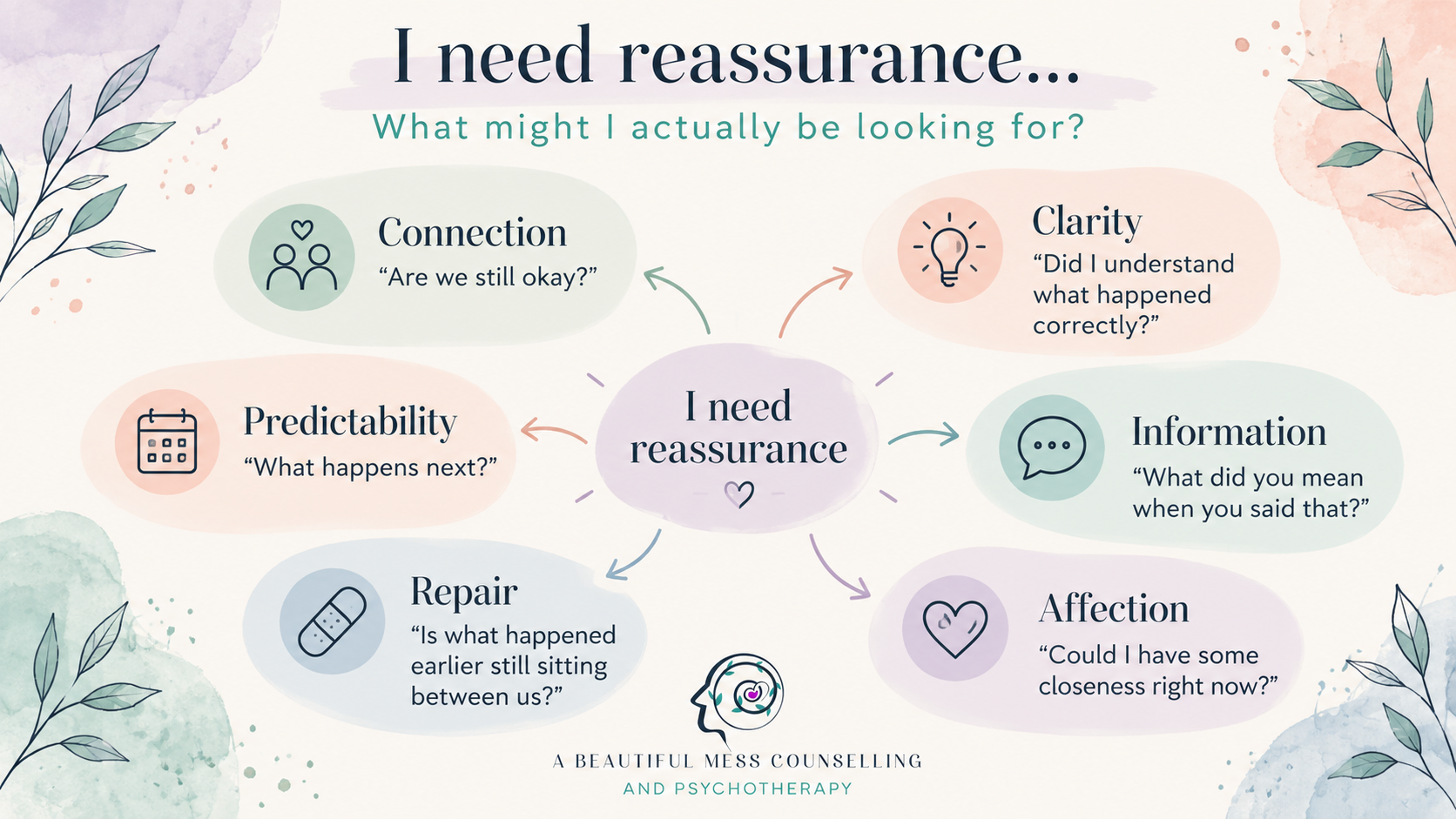
A vague need for reassurance can contain many different questions.
Perhaps there has been an argument and what you really want to know is:
“Are we still connected, even though we disagreed?”
Maybe your partner has seemed quieter than usual and you are wondering:
“Have I done something wrong?”
Perhaps a change in plans has left you unsettled and what you actually need is:
“Can you help me understand what is happening?”
Or maybe nothing obvious has happened at all, but you are feeling disconnected and wanting some sign that the relationship still feels emotionally available to you.
When we do not know the question underneath the reassurance, it can become very difficult for our partner to answer it.
“You love me, right?”
“Yes.”
“Are you sure?”
“Yes.”
“But are we okay?”
“Yes.”
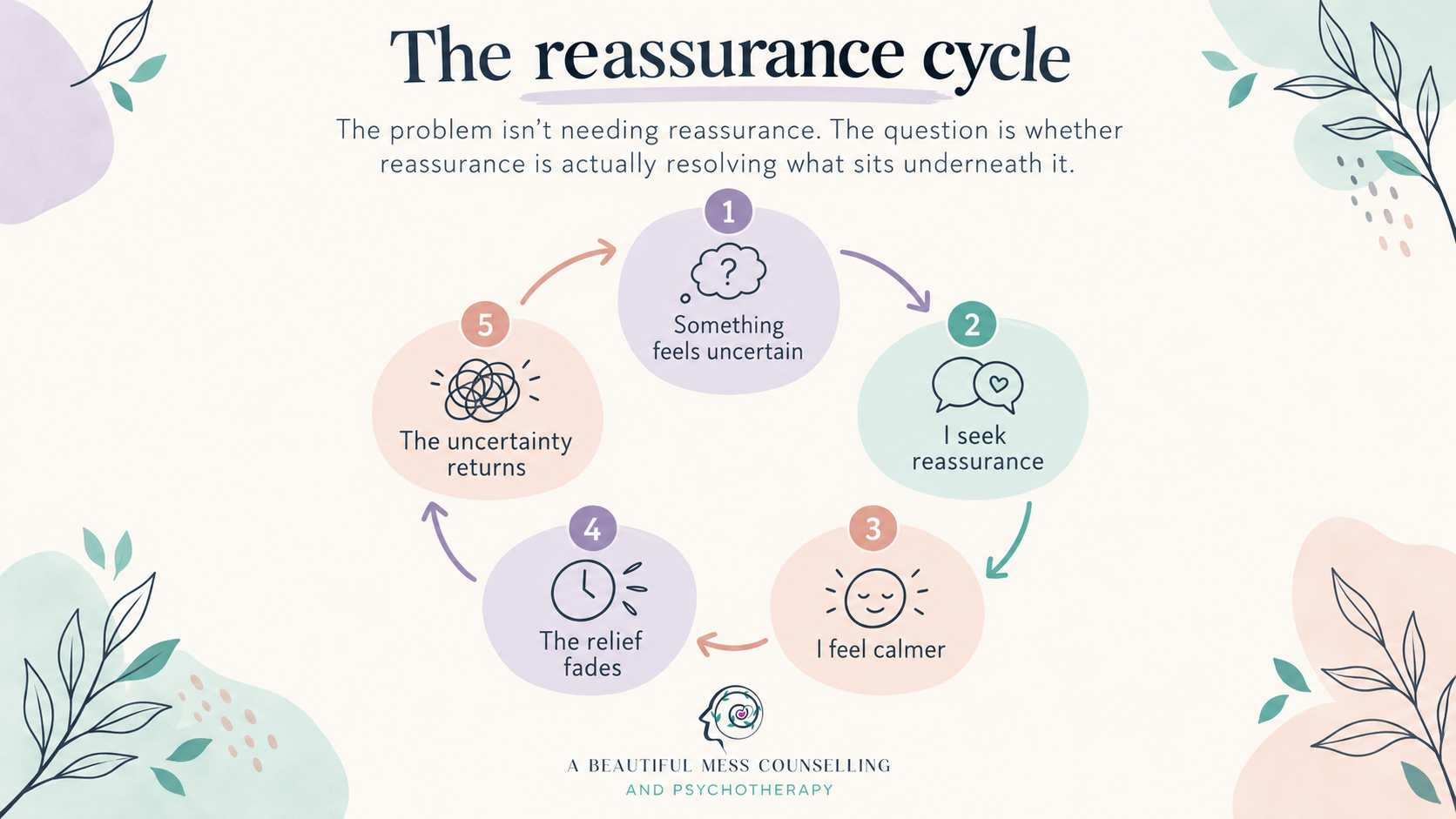
Reassurance can be really soothing in the moment. We ask, our partner tells us things are okay, and for a while we feel calmer.
The difficulty comes when that calm only lasts for a short time and we soon find ourselves needing to ask again. Over time, we can accidentally get caught in a loop where reassurance becomes the main way we manage uncertainty, rather than one of several ways we make sense of what we are feeling.
That does not mean reassurance itself is unhealthy.
It simply means that if we keep needing the same reassurance over and over, there may be something underneath the question that needs a little more attention.
Where attachment can come into it
Attachment theory can be useful here, provided we do not turn it into another set of labels with which to judge ourselves or our partners.
Research has shown that attachment anxiety and lower relationship trust are both associated with greater reassurance-seeking.
That makes sense.
If part of you is alert to the possibility that connection could disappear, ambiguous moments may feel particularly important.
A short text reply may become:
Are they losing interest?
A partner needing some quiet time after work may become:
Have I done something?
An unresolved disagreement may become:
What if this means the relationship is falling apart?
The wish for reassurance can be an attempt to settle that alarm system — essentially asking:
“Are you still there with me?”
But attachment is more complicated than “anxious people ask for reassurance and secure people do not”.
Some people have learned to do almost the opposite. Asking for comfort, closeness or reassurance may feel exposing, dependent or unsafe, so they minimise the need, shut it down or try to manage everything alone.
For those people, saying:
“Actually, I could use some reassurance right now”
can itself be a very vulnerable act.
So I would be cautious about advice that simply says, “Stop asking for reassurance.”
A more useful question may be:
What happens inside me when I am uncertain about our connection — and how have I learned to deal with that feeling?
Neurodivergence can add another layer
For neurodivergent people, reassurance can sometimes be connected not only to attachment, but also to communication, predictability and making sense of uncertain information.
Research exploring autistic people’s experiences of romantic relationships has found many of the same things that matter in other relationships — communication, respect, safety and feeling understood. But uncertainty and difficulty interpreting communication can create particular challenges for some autistic people.
That uncertainty matters.
If indirect communication is difficult to interpret, “You should just know I’m fine” may not actually provide very much information.
Someone may genuinely need to ask:
“Can you tell me directly whether you’re upset with me?”
or:
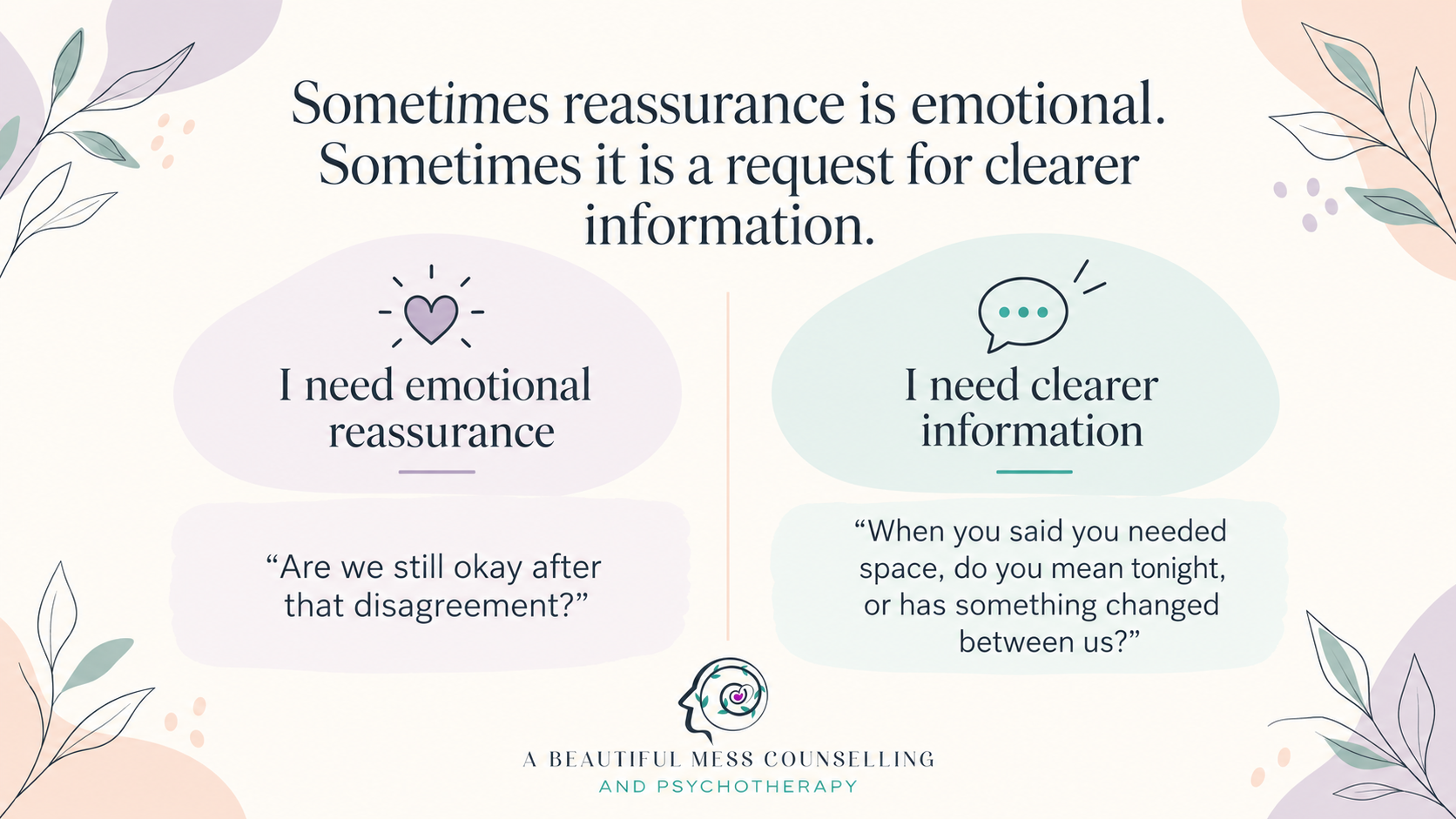
“When you said you needed space, did you mean you want some quiet tonight, or that something has changed between us?”
That is not necessarily excessive reassurance-seeking.
Sometimes it is a request for clearer information.
ADHD can bring its own complexities too.
Research exploring the relationship experiences of adults with ADHD has found that many describe things like feeling especially sensitive to rejection, struggling with big emotions in relationships, worrying that they are a burden to their partner, and finding that understanding their ADHD better can make a real difference.
For some people with ADHD, a small sign of frustration or perceived rejection can therefore feel much more significant than it might appear from the outside.
You may also have heard the term rejection sensitive dysphoria, or RSD. It is widely used within ADHD communities, although it is not currently a standalone clinical diagnosis. The broader idea of rejection sensitivity — being especially alert and reactive to possible rejection — is, however, well recognised in psychological research.
None of this means every autistic or ADHD person seeks reassurance, or that every need for reassurance should be explained by neurodivergence.
It simply means that before describing ourselves or someone we love as “needy”, it can be worth asking:
Is something about this situation unclear, unpredictable or particularly difficult to interpret?
What about polyamory and consensual non-monogamy?
The need for reassurance does not disappear simply because a relationship is non-monogamous.
Nor does needing reassurance mean that someone is “not cut out for polyamory”.
Research comparing consensually non-monogamous and monogamous relationships has generally found far fewer differences in relationship quality than many stereotypes would have us believe. Having more than one relationship does not automatically make those relationships less loving, secure or committed.
What can change is the context in which uncertainty appears.
Reassurance might involve questions such as:
Does our relationship still matter now that you are excited about someone new?
Has our agreement changed?
Do we still have protected time together?
If your feelings for another partner deepen, what does that mean for us?
Can I tell you I’m struggling without you hearing that as me asking you to end another relationship?
New Relationship Energy, or NRE, can be particularly powerful.
Research with people in polyamorous relationships shows that when a partner is caught up in NRE, the person on the other side can have a whole mix of responses. There might be genuine happiness and excitement for their partner, alongside jealousy, uncertainty, fear or discomfort.
How manageable those feelings feel can depend on lots of things — including how safe and connected the existing relationship feels, how well everyone can talk about what is happening, and how much capacity someone has to sit with uncomfortable emotions without immediately needing them to disappear.
It is entirely possible to support a partner’s other relationship and need some reassurance about your own.
Sometimes the answer is emotional reassurance.
Sometimes it is concrete clarity about agreements, time, communication or expectations.
And often it is a combination of both.
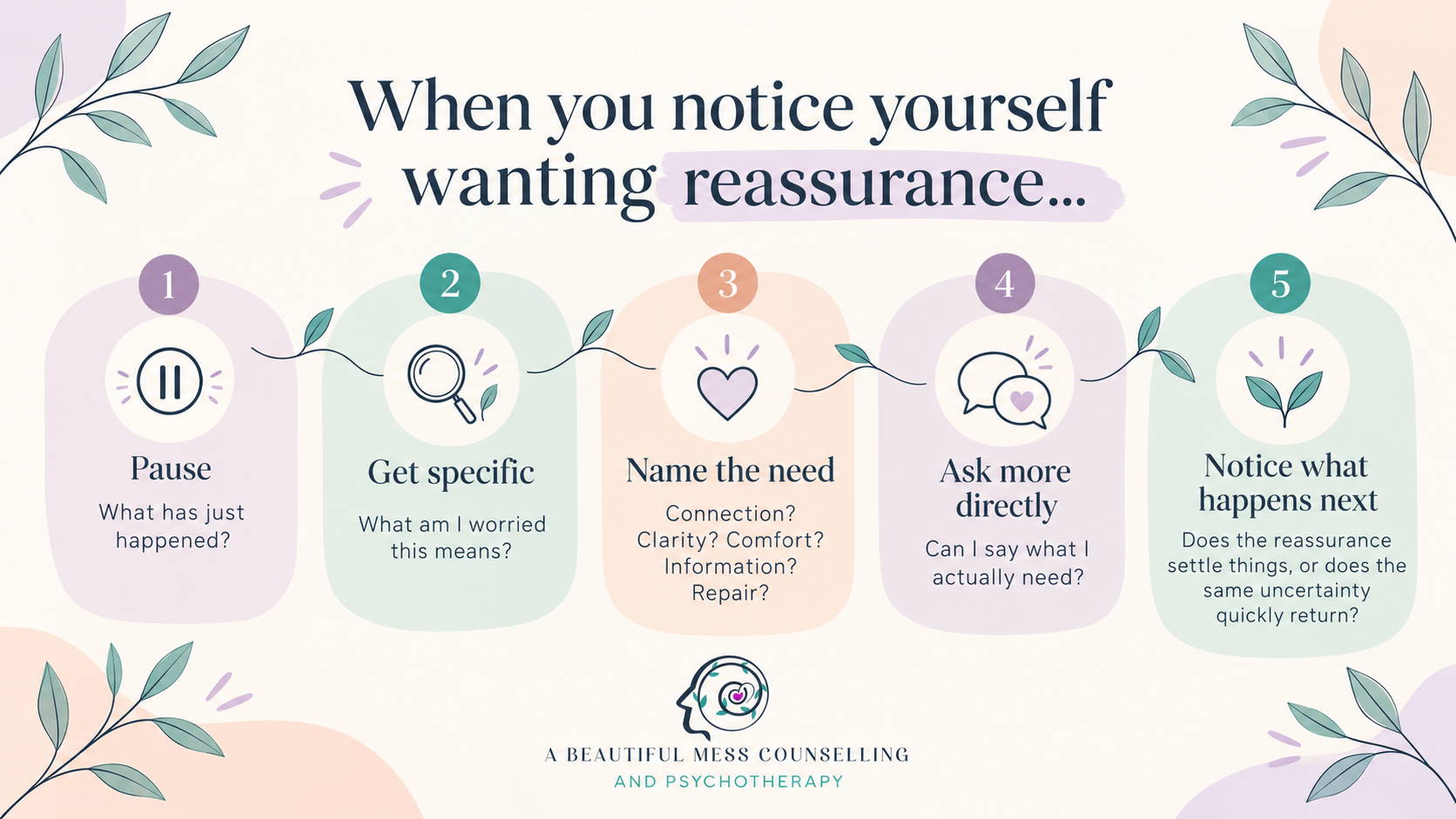
So what can you do when you notice yourself seeking reassurance?
You do not need to turn every vulnerable moment into a therapeutic exercise.
But a little curiosity can sometimes help.
Get more specific
Instead of simply asking:
“Are we okay?”
pause and see whether you can identify what you are actually worried about.
Perhaps:
“I noticed you became quiet after that conversation and I’m wondering whether I upset you.”
Or:
“I know we're okay generally. I think what I'm actually worried about is whether what happened earlier is still sitting between us.”
Specific questions tend to be easier to answer than a request for a general sense of safety.
Ask yourself what kind of reassurance you actually need
Are you looking for connection, information, clarity, affection, acknowledgement, predictability, repair after a hurt, or confirmation that an agreement still stands?
Sometimes you are not asking your partner to make your anxiety disappear.
You are asking them to help you understand something.
Notice whether the reassurance sticks
If your partner answers your question clearly and kindly, but a few minutes later your brain generates another version of the same fear, that may be worth noticing.
It does not mean you have done anything wrong.
It may simply mean that repeatedly answering the question is no longer resolving the thing underneath it.
That can be an opportunity to practise sitting with some uncertainty alongside receiving support from your partner — rather than deciding you must either manage everything alone or have your partner make the feeling disappear.
Try asking for what you need more directly
There is a difference between:
“Tell me you aren't going to leave me.”
and:
“I'm feeling quite vulnerable after that argument. Could you remind me that we're still on the same team while we work this out?”
Both may come from fear.
But the second gives your partner much more information about what is happening and what might actually help.
Or perhaps the need is clarity:
“Can you tell me what you meant earlier? I think I’ve filled in some of the gaps myself and I’m not sure my interpretation is accurate.”
Sometimes identifying the real question changes the conversation completely.
Reassurance is not the enemy
Healthy relationships are not built by becoming so independent that we never need anything from another person.
They are also not built by expecting our partner to remove every moment of uncertainty for us.
There is a lot of space between those two extremes.
We can learn to recognise when we need connection. We can understand the experiences that make uncertainty harder for us. We can become clearer about what we are actually asking for. And, over time, we can develop greater confidence in both our relationships and ourselves.
Sometimes the question is not:
“How do I stop needing reassurance?”
It is:
“What is this need trying to tell me — and how can I communicate that more clearly?”
For many people, that is a much kinder and more useful place to begin.
Relationship counselling at A Beautiful Mess
A Beautiful Mess Counselling & Psychotherapy offers relationship counselling for people in a range of relationship structures, including LGBTQIA+, neurodivergent, monogamous, polyamorous and other consensually non-monogamous relationships.
If patterns around reassurance, trust, disconnection or communication keep leaving you stuck, relationship counselling can provide a space to slow things down, understand what is happening underneath the pattern, and find ways of responding that fit your relationship.
Research informing this article
This article draws on research into adult attachment and reassurance-seeking, perceived partner responsiveness, autistic experiences of romantic intimacy, ADHD and romantic relationships, rejection sensitivity, consensual non-monogamy, and responses to New Relationship Energy in polyamorous relationships.