Why We Keep Having the Same Argument — and What the Pattern May Be Protecting
You have had the same argument three times this month.
Maybe this time it was about the dishes. Last time it was because someone was late. Before that, it was a message that went unanswered.
Or perhaps your recurring argument is about money, sex, parenting, household responsibilities, how much time someone spends on their phone, or something else entirely.
The topic changes.
But somehow, the conversation keeps ending in the same place.
One person feels unheard. Someone becomes defensive. Someone goes quiet. Someone pushes harder. Someone tries to fix everything.
And by the end, both of you are frustrated and neither of you feels particularly understood.
When this keeps happening, it is easy to start asking:
Who started it?
Who said the wrong thing?
Who needs to change?
But sometimes the more useful question is not “Who is the problem?”
It is:
“What keeps happening between us?”
Relationship difficulties are not always caused by one person being “the problem”. Sometimes a relationship becomes caught in a repeated pattern of communication and behaviour — and both people find themselves responding to that pattern again and again.
Understanding the pattern can give you somewhere different to begin.
The topic and the pattern are not always the same thing
The easiest part of an argument to see is usually what it appears to be about.
Imagine the topic is:
“You didn’t reply to my message.”
That is a real issue, and it may genuinely need to be discussed.
But the conversation around it might follow a familiar path:
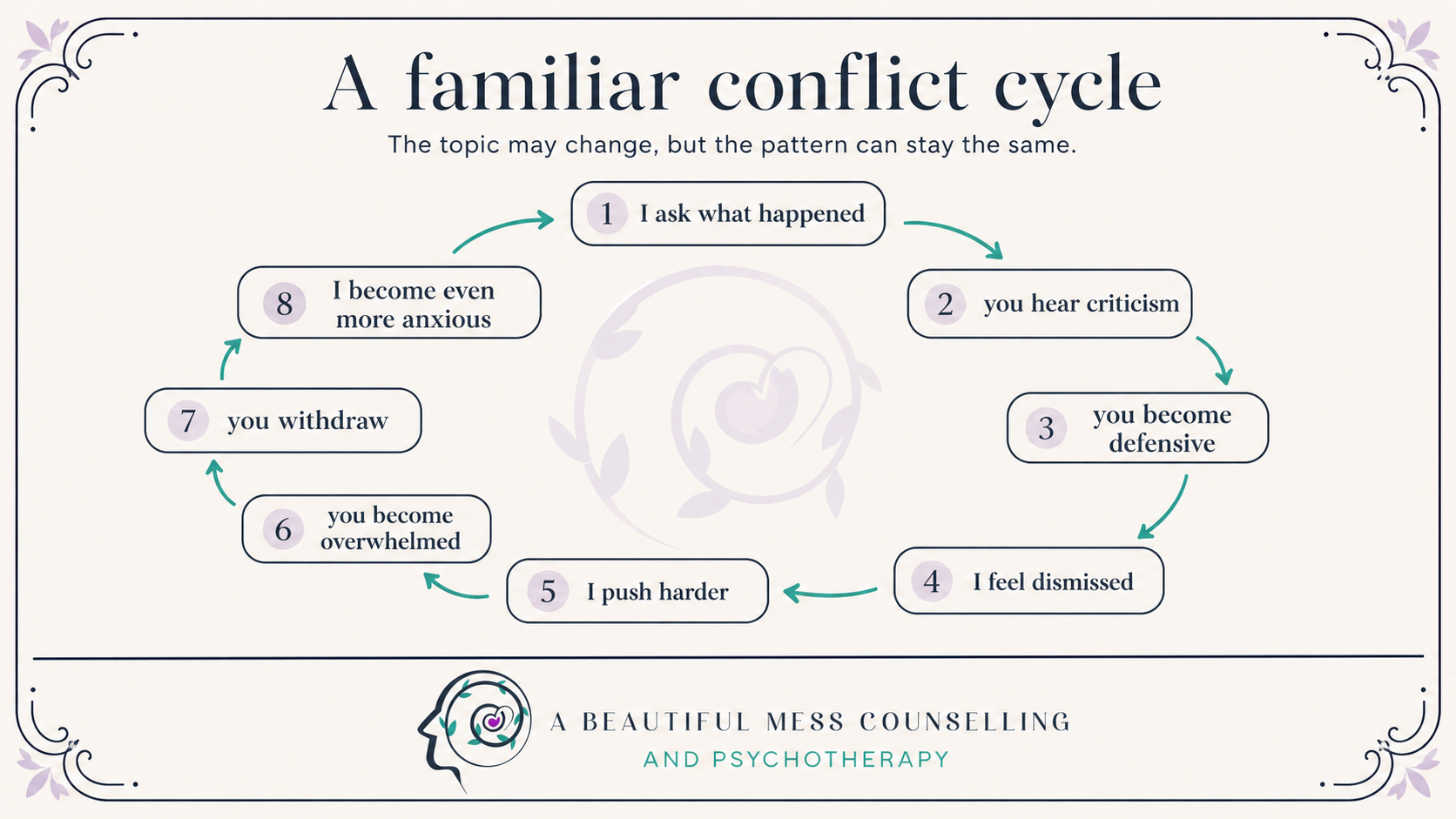
The next disagreement might be about something completely different.
But the pattern basically remains the same.
That is one reason repeated arguments can feel so exhausting. You may both be trying to deal with the thing in front of you while also reacting to everything that is happening around it.
Once a familiar cycle starts, reactions can become very quick.
One person may be thinking:
“They aren’t listening to me.”
The other may be thinking:
“Nothing I say is going to be good enough.”
One starts explaining more.
The other becomes quieter.
The quieter they become, the more urgent the first person feels.
The more urgent the first person becomes, the more overwhelmed the other person feels.
Before long, the unanswered message may barely be what the conversation is about anymore.
What might be sitting underneath the pattern?
What we see on the surface is not always the whole experience.
Underneath someone pushing for an answer may be someone frightened that something is wrong. They might be looking for reassurance, trying to reconnect, or feeling anxious about being ignored.
Someone pulling away may be overwhelmed, ashamed, confused, or frightened that anything they say will make the situation worse.
Sometimes:
criticism sits over hurt;
defensiveness protects against shame;
trying to fix everything helps someone manage anxiety;
going quiet helps someone manage overwhelm;
seeking reassurance comes from uncertainty or fear of disconnection; and
needing space is an attempt to regulate rather than an attempt to reject.
That does not mean every reaction needs a deep psychological explanation.
Sometimes irritation really is irritation.
Sometimes people are tired.
Sometimes someone misunderstood what was said.
Sometimes you are both hungry, stressed and trying to have an important conversation at 11 pm when neither of you has the capacity for it.
Instead of searching for a hidden explanation for everything, it can be useful to ask something simpler:
What am I feeling, needing or trying to protect when I respond this way?
And then:
What might be happening for the other person that I cannot see from where I am standing?
Understanding a pattern does not remove accountability
Looking beneath someone’s behaviour is not the same as excusing it.
If an agreement has been broken, a boundary crossed or someone has behaved in a way that causes harm, that still matters.
A person can be overwhelmed and still be responsible for how they speak to someone.
Someone can be frightened of abandonment and still need to respect another person’s need for space.
Someone can shut down during conflict and still have responsibility for returning to an important conversation later.
Understanding why something happens can help us respond differently.
It does not make harmful behaviour acceptable.
The aim is not to decide that nobody is responsible because “it is just the pattern”.
The aim is to understand more of what is happening while still taking responsibility for how we behave within it.
Healthy relationships are not one-size-fits-all
Relationship patterns also do not look the same in every relationship.
Your neurotype, identity, communication style, sensory needs, experiences and relationship structure can all influence what happens during conflict.
One person may need time to process before they can respond.
Another may feel much safer talking something through immediately.
Someone may communicate very directly and believe they are simply being clear, while the person hearing them experiences the same communication as harsh.
A neurodivergent person may become quiet, lose access to words or need space because they are overwhelmed — not because they do not care about the conversation.
Relationship structure can shape these conversations too.
ENM and polyamorous relationships may involve navigating agreements, time, jealousy, boundaries, changing needs and multiple relationships.
LGBTQIA+ relationships may also exist alongside experiences involving family acceptance, identity, visibility, minority stress or previous stigma.
Kink-involved relationships may have their own agreements, roles, boundaries and ways of communicating that make little sense if someone approaches them using assumptions about what relationships are “supposed” to look like.
None of this means difficult communication should simply be accepted.
It means there is no single template against which every healthy relationship should be measured.
The question is not:
“Does our relationship look normal?”
A more useful question may be:
“Does the way we relate actually work for the people in this relationship?”
Naming the pattern instead of blaming the person
When conflict becomes familiar, our language can easily turn towards describing the other person.
“You always shut down.”
“You never listen.”
“You make everything into an argument.”
“You’re impossible to talk to.”
Sometimes it can help to shift from describing the person as the problem to describing the interaction that keeps happening between you.
Instead of:
“You always shut down whenever I try to talk to you.”
You might try:
“I’ve noticed that when I push for an answer, you seem to pull away. Then I become more anxious and push harder, and we both end up frustrated.”
That creates room to look underneath the pattern.
Perhaps:
“I think I’m pushing because I’m scared we’re not okay.”
And perhaps the other person can then say:
“I’m not trying to ignore you. I’m overwhelmed and worried I’ll make things worse.”
Neither person has suddenly become a perfect communicator.
The issue has not magically disappeared.
But the conversation has moved from:
“You are the problem.”
towards:
“This is the pattern we keep getting caught in.”
And that gives you something you can begin working on together.
You do not have to wait until everything is breaking
Relationship counselling is sometimes treated as something people seek when a relationship is already on the verge of ending.
It does not have to be.
People seek support for all kinds of reasons.
Maybe the same argument keeps returning.
Perhaps communication has become harder recently.
There may be resentment beginning to build.
Something in the relationship might have changed.
There may be hurt that needs repairing, boundaries that need discussing, different needs that have become difficult to negotiate, or questions around trust, intimacy or connection.
Or perhaps nothing is dramatically “wrong”.
You simply want to understand each other better.
Relationship counselling can provide somewhere to slow the pattern down enough to see it.
Not to decide which person is the problem.
Not to force your relationship into somebody else’s idea of what it should look like.
But to become curious about what happens between you, what each person may be experiencing underneath it, and whether there are different ways you would like to respond.
Asking for support in your relationship is not weakness.
And you do not have to wait until everything is breaking before you seek it.
Further reading
If you would like to explore some of these ideas further:
Relationships Australia — Relationship Advice
Accessible Australian information about communication, conflict, intimacy and respectful relationships.The Gottman Institute — The Four Horsemen
An introduction to criticism, contempt, defensiveness and stonewalling, and how these patterns can affect relationship conflict.The Gottman Institute — The Antidotes to the Four Horsemen
Practical alternatives for responding differently when familiar conflict patterns emerge.ICEEFT — What is Emotionally Focused Therapy?
A public-friendly introduction to Emotionally Focused Therapy and the idea of understanding emotional connection and recurring relationship patterns.Reframing Autism — Navigating Love and Relationships as an Autistic Adult
A neurodiversity-affirming discussion of relationships, communication differences and the importance of relational accommodations.Healthdirect Australia — Building and Maintaining Healthy Relationships
Straightforward Australian information about communication, listening, support and healthy relationships.Modern Polyamory — New to Polyamory? A Beginner’s Guide to Consensual Non-Monogamy
An accessible introduction to polyamory and consensual non-monogamy, including common terminology, different relationship structures, boundaries, agreements and communication. It also explores the importance of building relationships intentionally rather than assuming there is one “right” way for relationships to look.
Books
Sue Johnson — Hold Me Tight: Seven Conversations for a Lifetime of Love
Based on Emotionally Focused Couple Therapy, with a strong focus on recognising recurring cycles and understanding the emotions and attachment needs beneath them.John Gottman & Julie Schwartz Gottman — Fight Right: How Successful Couples Turn Conflict Into Connection
A practical, research-informed book about understanding conflict and responding to disagreement in ways that support connection rather than simply trying to “win” an argument.Jessica Fern — Polysecure: Attachment, Trauma and Consensual Nonmonogamy
Particularly useful for readers in ENM and polyamorous relationships. Fern applies attachment concepts to consensual non-monogamy and explores ways of developing security without assuming that monogamy is the default or ideal relationship structure.
A note about relationship safety
Understanding a recurring relationship pattern does not mean that both people are necessarily equally responsible for what is happening. Patterns involving intimidation, coercion, control, fear or abuse need to be understood differently from ordinary relationship conflict. 1800RESPECT describes coercive control as a persistent pattern of behaviour used to dominate, control or isolate another person.
For Australian information about relationship safety and coercive control, visit 1800RESPECT — Coercive Control.