What Neurodiversity-Affirming Counselling looks like in practice.
You may have seen the words neurodiversity-affirming counselling on a therapist’s website and wondered what they actually mean.
Does it simply mean the counsellor works with autistic people or people with ADHD? Does it mean that every difficulty is blamed on neurodivergence? Is it a particular type of therapy?
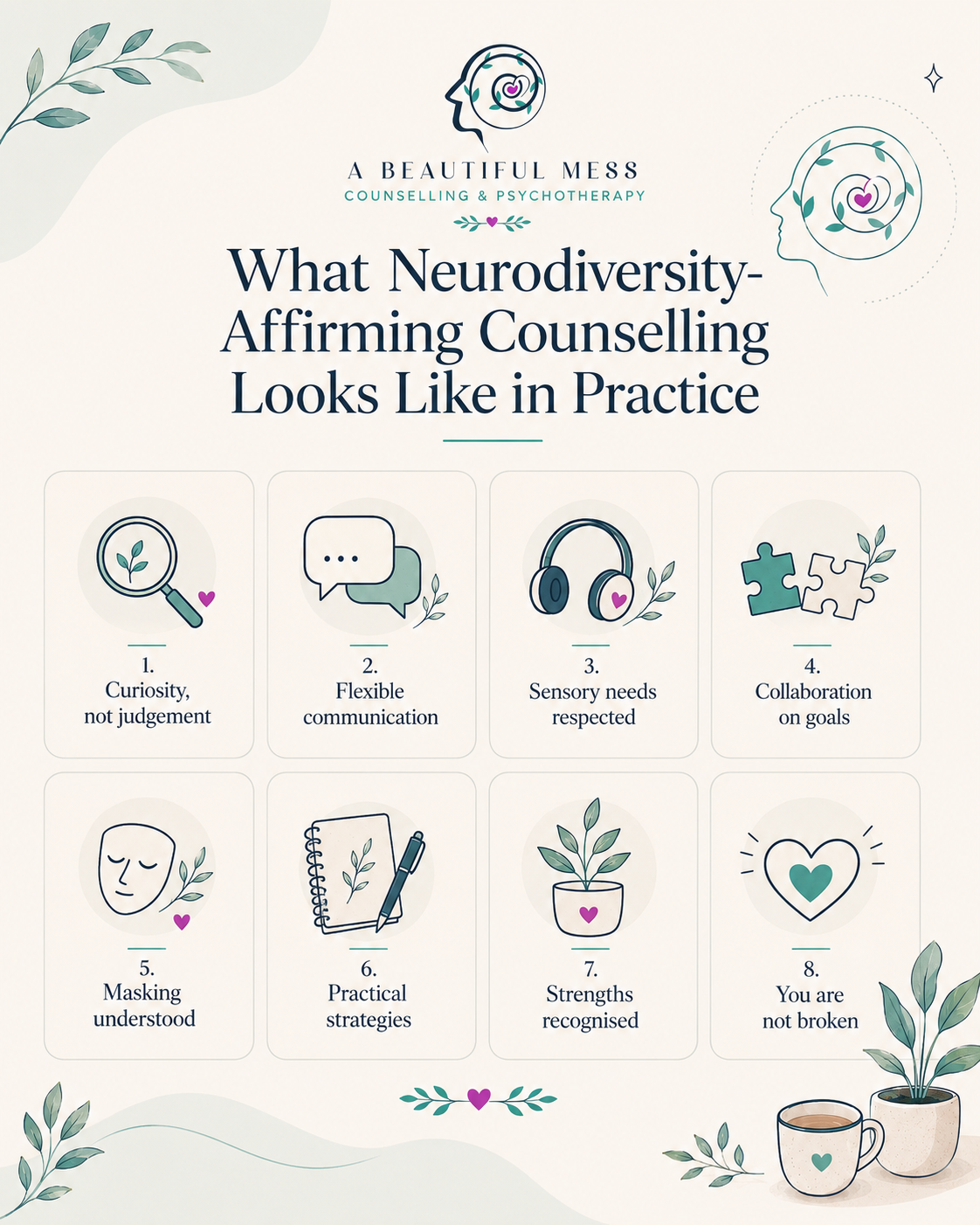
Neurodiversity-affirming counselling is not one specific therapy technique. It is a way of approaching counselling that respects the different ways people think, communicate, process information, experience emotions and move through the world.
Most importantly, it starts from the belief that neurodivergent people are not broken versions of neurotypical people.
What do we mean by neurodiversity?
Neurodiversity describes the natural variation between human brains. We all process the world differently, although some ways of thinking, learning and functioning are more common than others.
The term neurodivergent is often used by people whose brains work in ways that differ from what society considers typical. This can include autistic people, people with ADHD, AuDHD, dyslexia, dyspraxia, Tourette syndrome and other forms of neurodivergence.
Neurodivergence is not a single experience. Two people with the same diagnosis may have very different strengths, difficulties, communication preferences and support needs. Some people also identify as neurodivergent without having, wanting or being able to access a formal diagnosis.
So, what might a neurodiversity-affirming approach actually look like when you enter the counselling room?
You are not treated as a problem to be fixed
Many neurodivergent people have spent years receiving messages that they are too sensitive, too distracted, too intense, too quiet, too emotional or simply not trying hard enough.
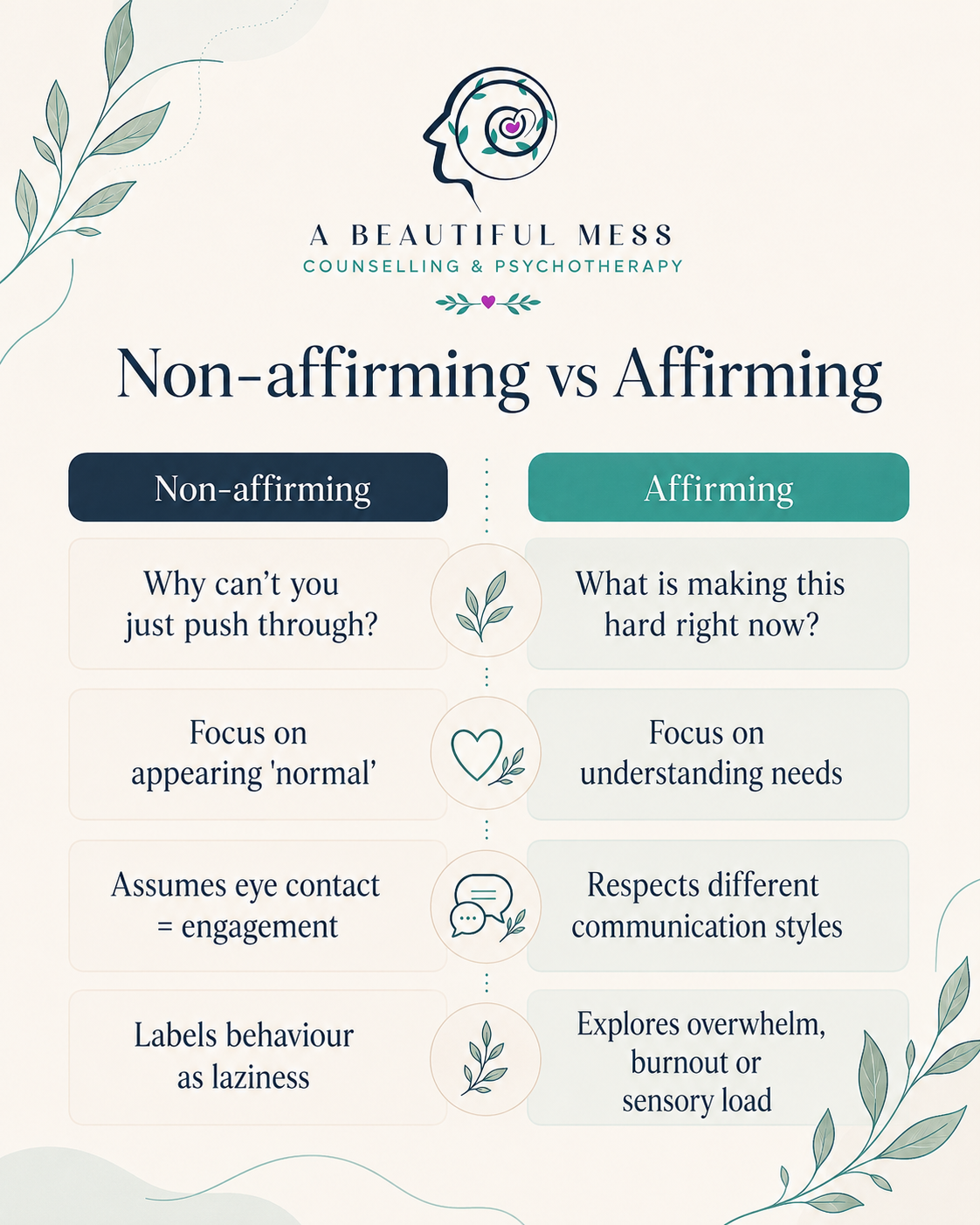
Neurodiversity-affirming counselling does not begin by asking:
How can we make you appear more normal?
Instead, we might ask:
What is happening for you? What is making this difficult? What support would help?
This does not mean pretending that everything is easy or that neurodivergence never causes genuine difficulties. Autism, ADHD and other forms of neurodivergence can involve significant disability, exhaustion and support needs.
An affirming approach makes room for those realities without suggesting that your entire way of being needs to be corrected. The focus is on understanding your needs and helping you build a life that works more effectively for you.
Behaviour is explored with curiosity
In neurodiversity-affirming counselling, behaviour is not automatically labelled as laziness, resistance, attention-seeking or a lack of motivation.
What looks like avoidance might actually be overwhelm.
What looks like procrastination might involve task paralysis, difficulty knowing where to begin or fear created by years of criticism.
What looks like anger might be sensory overload, frustration, anxiety or a nervous system that has reached its limit.
What looks like disengagement might be exhaustion after spending the day masking at work or school.
Rather than jumping straight to judgement, we become curious about what the behaviour may be communicating.
That does not mean avoiding responsibility. It means understanding what is driving a pattern so that we can find strategies that are realistic, respectful and more likely to help.
The counselling environment can be adjusted
A traditional counselling room does not automatically feel comfortable or accessible to everyone.
Bright lights, ticking clocks, background noise, strong scents, an unfamiliar waiting room or the expectation of sitting still and maintaining eye contact can all make it harder to concentrate and feel safe.
Neurodiversity-affirming counselling may involve making simple adjustments, such as:
reducing lighting or background noise;
using fidgets or other sensory tools;
allowing movement during the session;
offering telehealth or walk-and-talk counselling;
allowing you to sit somewhere other than a traditional chair;
providing clear information about what will happen;
giving you time to settle before beginning difficult conversations.
You are also not expected to maintain eye contact to prove that you are listening. Looking away, moving, drawing or using a fidget may actually help you concentrate.
Sensory and communication needs are part of the counselling process, rather than something you are expected to leave at the door.
Communication does not have to happen in one particular way
Talking face-to-face for an hour can be helpful for some people. For others, it can be tiring, uncomfortable or difficult to process in the moment.
A neurodiversity-affirming counsellor recognises that communication can take different forms.
You might find it easier to:
write something down;
use a diagram, image or feelings chart;
bring notes to your appointment;
email important information before the session;
take time before answering;
use creative activities or metaphors;
talk while walking or doing another activity;
ask for a question to be reworded;
receive a written summary after discussing something complicated.
You may also need silence while you work out what you are feeling or how to put an experience into words. Silence is not a failure to participate.
Counselling should not become another environment where you feel pressured to communicate in a way that suits everyone except you.
Your goals are developed with you
Neurodiversity-affirming counselling is collaborative.
The counsellor should not decide that the goal is to make you appear less autistic, stop harmless stimming, become more socially conventional or tolerate environments that are continually harming your wellbeing.
Instead, we look at what matters to you.
Your goals might include:
understanding your emotions and nervous system;
recovering from autistic or ADHD burnout;
reducing anxiety;
recognising sensory needs;
developing boundaries;
finding more manageable routines;
navigating relationships;
understanding a late autism or ADHD diagnosis;
reducing shame;
communicating your needs;
processing trauma, grief or difficult life experiences;
creating a life that requires less constant masking.
Success will not look exactly the same for every neurodivergent person. Your definition of a meaningful, manageable life should guide the work we do together.
Masking can be explored without pressure
Masking is the process of hiding, suppressing or changing parts of yourself to meet social expectations.
It might involve forcing eye contact, rehearsing conversations, copying other people’s expressions, hiding sensory distress, holding in the need to move or pretending to understand something when you need clarification.
Masking can sometimes help people navigate situations that do not feel safe or accepting. For that reason, counselling should not simply demand that a person “unmask” everywhere.
Instead, we can explore:
where you feel pressure to mask;
what masking costs you;
when it may have helped protect you;
which relationships feel safer;
what parts of yourself you would like to express more openly;
how to make choices about disclosure and boundaries.
The aim is not to replace one rigid expectation with another. It is to give you more awareness, choice and control.
Strengths and interests are welcomed
A strengths-based approach does not mean using forced positivity or pretending that difficult experiences do not matter.
It means recognising that your interests, knowledge, creativity, humour, persistence, honesty and particular ways of seeing the world may be valuable parts of who you are.
Special interests and passions can also provide comfort, connection, motivation and a useful way into counselling conversations.
You do not have to leave your interests outside because they do not seem “serious” enough for therapy. Dinosaurs, video games, history, music, books, craft, fitness, fandoms and favourite characters can all become meaningful tools for exploring identity, emotions, relationships and experiences.
Practical support can be part of counselling
Sometimes insight is helpful. Sometimes you also need practical ways to make everyday life more manageable.
For someone with ADHD, simply understanding why a task is difficult may not be enough. We may also need to explore task initiation, external reminders, realistic routines, breaking activities into smaller steps or reducing the number of decisions involved.
For an autistic person, anxiety may be connected to unpredictability, sensory demands, communication misunderstandings or repeated experiences of being judged.
Rather than relying only on generic advice, we can explore strategies that match your actual brain, circumstances and capacity.
This might include visual planning, scripts for difficult conversations, sensory regulation, preparation for transitions, body-based grounding, clearer boundaries or finding ways to recover after demanding social situations.
Neurodiversity is not the only part of you
Neurodivergent people also have relationships, cultures, identities, responsibilities, histories and communities.
A person may be navigating neurodivergence alongside sexuality, gender, chronic illness, disability, parenting, trauma, work pressures, cultural expectations or relationship structures that are not always understood by mainstream services.
Neurodiversity-affirming counselling should recognise the whole person rather than reducing every experience to autism or ADHD.
Sometimes neurodivergence will be central to what we discuss. At other times, it may simply shape how we approach a completely different concern.
What neurodiversity-affirming counselling is not
An affirming approach does not mean:
ignoring distress or disability;
assuming every neurodivergent person has the same experience;
avoiding difficult conversations;
excusing harmful behaviour;
turning every trait into a “superpower”;
deciding that neurodivergence explains everything;
using a few sensory tools while continuing to hold deficit-based beliefs.
It also does not mean that every strategy will work for every person.
Being affirming requires flexibility, curiosity and a willingness to listen when someone says that an approach is not helping.
Who can access neurodiversity-affirming counselling?
You might benefit from neurodiversity-affirming counselling if you:
are autistic, have ADHD or identify as otherwise neurodivergent;
have recently received a diagnosis;
are exploring whether you may be neurodivergent;
are experiencing autistic burnout, ADHD burnout or masking fatigue;
feel that previous counselling approaches did not understand you;
want support with anxiety, trauma, relationships, identity or life transitions;
are looking for counselling for a neurodivergent child or teenager;
want to better understand and support a neurodivergent family member.
You do not need to prove that you are “neurodivergent enough” before your needs can be taken seriously.
Finding a neurodiversity-affirming counsellor
When looking for an autism-affirming or ADHD-informed counsellor, it can be helpful to ask:
How do you adapt sessions for different communication needs?
How do you understand masking and burnout?
Can the sensory environment be adjusted?
Do you involve clients in setting their own goals?
How do you stay informed about neurodiversity-affirming practice?
Are you comfortable supporting people who are exploring neurodivergence without a formal diagnosis?
What options do you offer if traditional seated talk therapy is difficult?
A genuinely affirming practitioner should be willing to answer these questions and acknowledge that they are still learning.
Neurodiversity-affirming counselling in Brisbane and online
At A Beautiful Mess Counselling & Psychotherapy, I offer neurodiversity-affirming counselling for adults, young people and parents in Brisbane, as well as online counselling across Queensland.
My approach is warm, collaborative and flexible. Sessions may include conversation, practical strategies, visual tools, creative activities, movement, walk-and-talk counselling or simply having space to slow down and make sense of what has been happening.
You are not required to mask, perform or arrive with the perfect explanation for why you need support.
You are welcome to begin exactly where you are.