Your partner apologised.
Maybe it was a good apology. They took responsibility. They seemed genuinely sorry. Perhaps you even believe them when they say they never meant to hurt you.
So why are you still hurt?
Why does the argument keep replaying in your mind? Why do you still feel a knot in your stomach when something reminds you of what happened? Why do you find yourself wanting to talk about it again when part of you is saying:
“They apologised. Shouldn’t I be over this by now?”
Not necessarily.
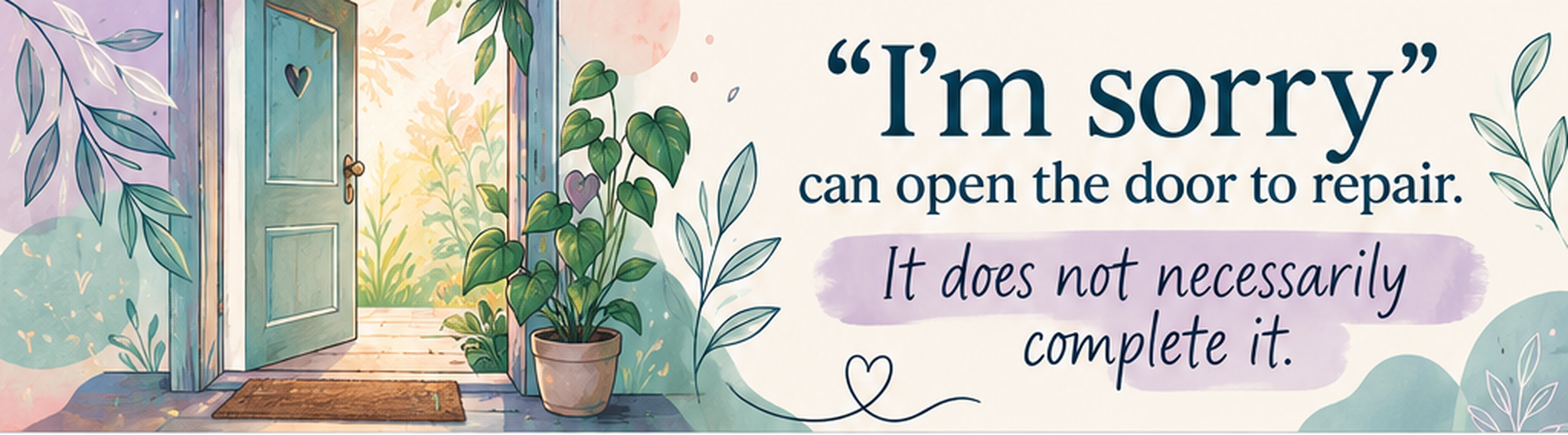
An apology can be sincere, important and meaningful — and the emotional injury can still be unfinished.
Research shows that apologies can support forgiveness and begin rebuilding trust. But apologies are only one part of relational repair. What happens after the apology matters too. Sometimes words need to be followed by understanding, responsiveness and different behaviour before the relationship starts to feel settled again.
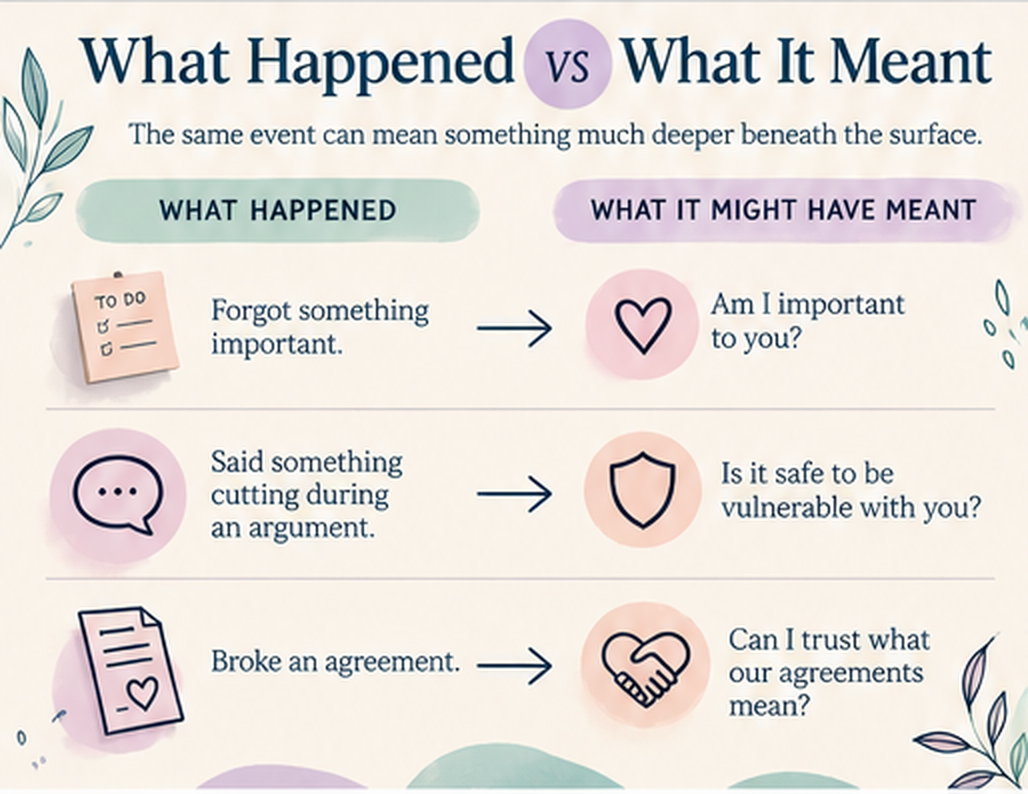
Sometimes the apology addresses what happened, but not what it meant
Behaviour and the emotional meaning behind it are not always the same. Your partner might genuinely apologise for forgetting something important, saying something hurtful or breaking an agreement.
But underneath the event may be a much more vulnerable question:
“Am I important to you?”
“Is it safe to be vulnerable with you?”
“Can I trust what our agreements mean?”
This is one reason couples can get stuck after an apology.
One person is thinking:
“I acknowledged what I did and said sorry. What else am I supposed to do?”
While the other is thinking:
“I still don’t think you understand what this did to me.”
Neither person necessarily has to be acting in bad faith. They may simply be talking about two different layers of the hurt.
Some hurts touch something deeper in the relationship
Emotionally Focused Couple Therapy talks about attachment injuries — moments in which someone experiences their partner as unavailable, unresponsive or unsafe at a time when they particularly needed them.
Research into attachment injuries has found that unresolved incidents can become recurring themes in distressed relationships, while resolving them in Emotionally Focused Therapy has been associated with improvements in relationship satisfaction and forgiveness.
Sometimes the event looks relatively small from the outside.
But emotionally, the experience may have been:
“When I needed you, I felt alone.”
“When I showed you how much I was hurting, I felt dismissed.”
“I reached for you and felt you move away.”
When that is the injury, apologising for the surface behaviour may not reach the part that was actually hurt. Repair often requires understanding the emotional meaning, too.
Forgiving someone is not the same as immediately trusting again
We sometimes talk about forgiveness as though someone should move directly from apology to a clean slate.
Relationships are rarely that tidy.
You may accept that your partner is genuinely remorseful and still feel cautious. You might forgive them and still need time before you trust that it won’t happen again.
Research on forgiveness in close relationships suggests that post-hurt trust matters. Sometimes your mind understands the apology before the rest of you feels safe again.
You may still be wondering:
Can I rely on you differently next time?
Will the behaviour actually change?
Can we talk about this without you becoming defensive?
Do our agreements still mean the same thing?
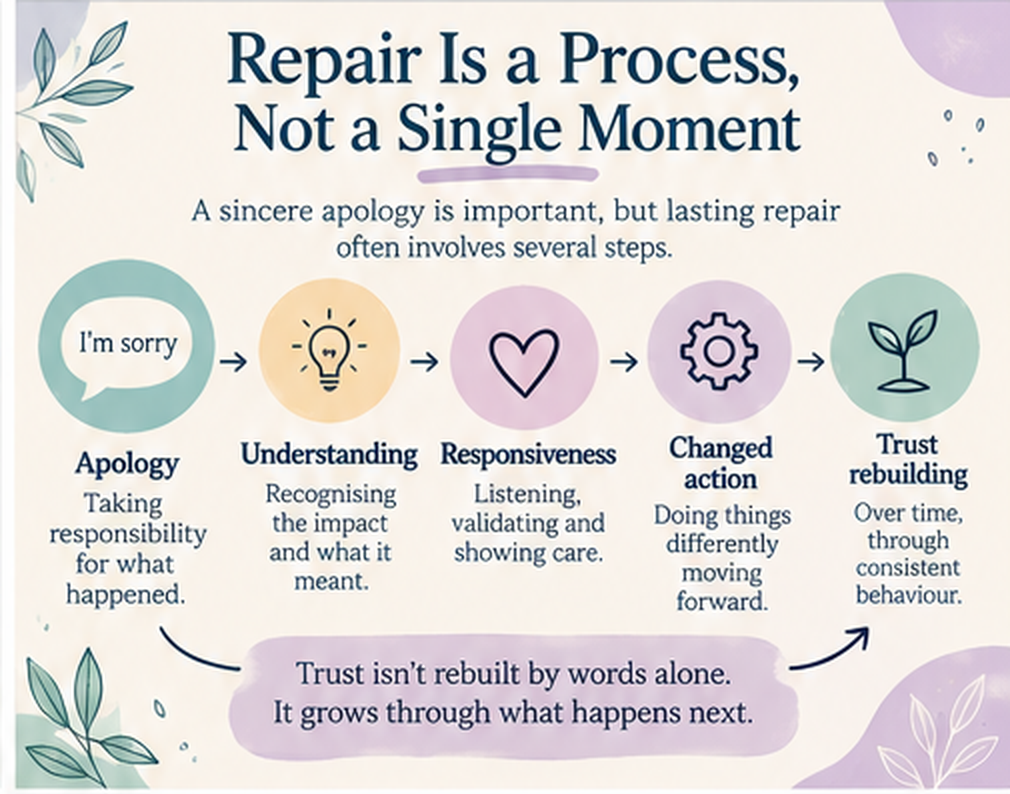
Trust is often rebuilt through what happens after the apology.
Repair is more than saying the perfect words
Apologies matter. But repair usually involves more than finding the right sentence.
There may also need to be:
understanding of the impact;
recognition of what the moment came to mean;
space for the hurt without immediately correcting or defending;
and changed behaviour over time.
If someone says:
“I understand why that damaged your trust”
and then responds differently when something similar happens again, the relationship receives new information. If the same pattern continues repeatedly, the relationship receives information too.
Why “That wasn’t what I meant” can make repair harder
Intent matters.
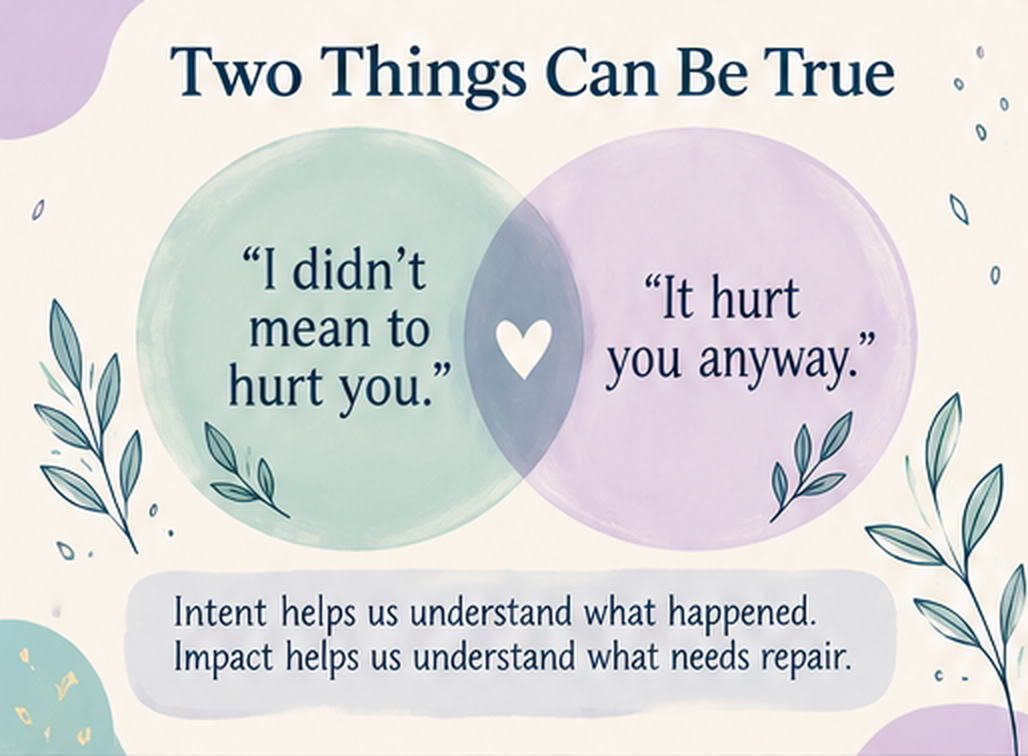
There is a difference between deliberately trying to hurt someone and hurting them unintentionally. But intent and impact are two different pieces of information. If I accidentally step on your foot, explaining that I did not mean to step on it doesn’t make your foot stop hurting.
When somebody says:
“That wasn’t what I meant,”
they may be trying to communicate:
“Please don’t believe I would deliberately hurt you like that.”
But the hurt partner may hear:
“You shouldn’t be this upset because I didn’t intend it.”
Both can be true:
“I didn’t intend that impact.”
and
“I can see that this was the impact anyway.”
Neurodivergence can make repair look different
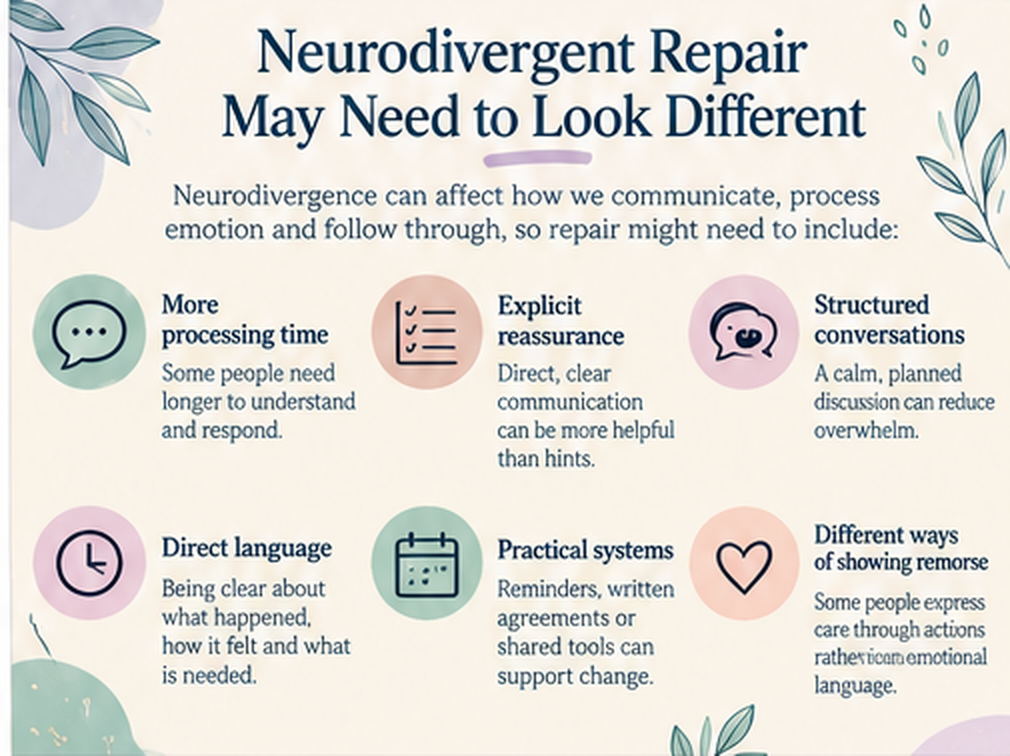
There is no single “neurodivergent relationship”. Neurodivergent people do not all communicate, process emotion or experience conflict in the same way. But neurodivergence can add important layers to repair.
Research involving autistic adults and neurodiverse couples highlights communication, mutual understanding, respect and safety as important parts of intimacy.
One person may feel:
“I said sorry. Of course that means I understand this upset you.”
while their partner may need something much more explicit:
“Can you tell me what you think hurt me about what happened?”
For some people, implied remorse, subtle reassurance or indirect communication simply does not provide enough information. Processing time can matter too.
One person may know immediately how they feel. Another may leave the conversation believing they are fine and realise hours or even days later:
“Actually, that really hurt.”
That later realisation does not make the hurt less legitimate.
ADHD, rejection and the meaning we give a hurt
ADHD can add another layer.
Research into adults’ experiences of ADHD in romantic relationships has found themes including sensitivity to rejection, strong emotional responses, worries about being a burden and the importance of greater self-understanding.
An event may therefore connect with questions like:
“Am I too much?”
“Are you getting tired of me?”
“Do you actually want me here?”
That does not mean every hurt reaction is “just rejection sensitivity”. Sometimes a partner genuinely did something hurtful.
A more useful question might be:
“What happened, and what did my nervous system understand that event to mean?”
Both deserve attention.
Neurodivergence can also affect the person apologising
Someone may genuinely understand that their behaviour was hurtful but struggle to find emotional language quickly.
They may become overwhelmed during an intense discussion, prefer a more structured conversation, or show remorse more naturally through actions.
Executive-function differences can also affect follow-through. “I promise I’ll remember next time” may be completely sincere. But if remembering is consistently difficult, sincerity alone may not change the outcome.
Repair might need a practical system: reminders, a shared calendar, clearer written agreements or another form of external support.
Sometimes building a system is an act of care.
Neurodivergence can explain why something is difficult without making the impact on the other person irrelevant. Affirming relationships make space for both.
What if the relationship is polyamorous or consensually non-monogamous?
The basics of repair do not suddenly change when a relationship is non-monogamous. People still need honesty, care, accountability, responsiveness and trust.
But the content of the rupture can be different.
Perhaps an agreement about disclosure was not followed.
Sexual health information may not have been shared when expected.
New Relationship Energy may have changed how you distributed time or attention.
You may have understood an agreement differently.
Or information about another partner may have been shared without consent.
Sometimes the deeper injury is:
“I did not object to you having another relationship. What hurt was feeling that ours stopped mattering.”
Current CNM research highlights communication around jealousy, sexual-health practices, disclosure, boundaries, reassurance and the distribution of time and resources as important parts of relationship maintenance.
So an ENM repair conversation may need to ask:
Did we understand the agreement in the same way?
What was the agreement trying to protect?
What information do we each need going forward?
Does something need to be renegotiated?
How do we repair this without automatically treating another relationship as the problem?
Experiencing jealousy, insecurity, or hurt does not automatically mean someone wants monogamy.
You can genuinely support your partner’s other relationship and be hurt by something that happened within your own.
If you are the person who is still hurting
Instead of asking yourself:
“Why can’t I just get over this?”
try asking:
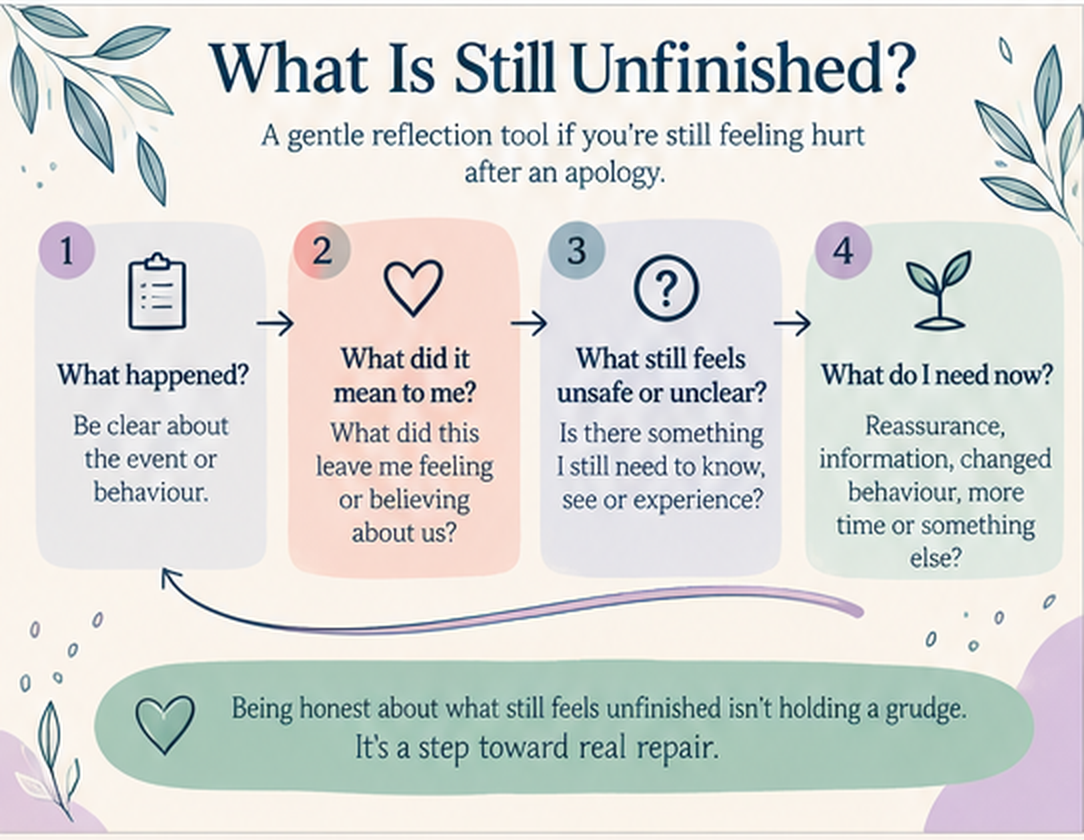
“What is still unfinished?”
Perhaps you still feel misunderstood.
Perhaps you are waiting to see whether behaviour changes.
Perhaps the event connected to an older fear.
Perhaps you need reassurance, information, accountability, affection, a clearer agreement or simply to feel that your partner understands the impact.
Sometimes a useful sentence is:
“I believe that you’re sorry. I think there is still something about what happened that doesn’t feel repaired for me yet.”
That is very different from:
“Your apology wasn’t good enough.”
If you are the person who apologised
It can be frustrating to feel as though you have taken responsibility and your partner is still hurt.
You may start thinking:
“What else can I possibly say?”
Sometimes the answer is not another apology. It is curiosity.
You might ask:
“Can you help me understand what still feels unfinished?”
“What part hurts the most now?”
“What did my behaviour leave you feeling or believing about us?”
“Is there something you need from me now that I haven’t understood yet?”
“What would help rebuild trust?”
The goal is not to accept blame for things you did not do or to sit indefinitely in punishment.
It is to understand whether an important part of your partner’s experience still has not been heard.
A simple repair conversation
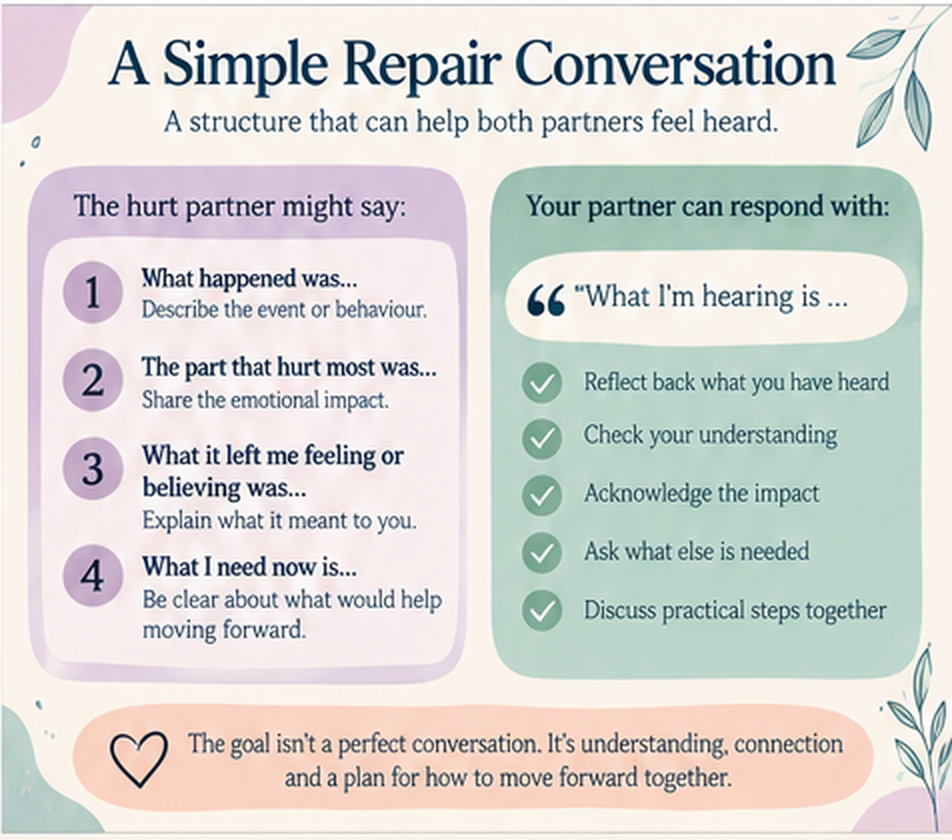
If both people feel safe enough to talk, slowing the conversation down can help.
Rather than debating what happened straight away, the hurt partner might describe:
What happened.
What hurt most.
What it left them feeling or believing.
What they need now.
The other partner’s first task is not necessarily to explain. It may simply be to understand.
Then the conversation can move toward:
“What would repair look like from here?”
Sometimes the answer is reassurance.
Sometimes it is an agreement.
Sometimes it is practical change.
Sometimes it is time.
Often, it is a combination.
Repair does not mean you have to erase what happened
A repaired relationship isn't necessarily one where nobody remembers the injury.
The aim is not amnesia.
Over time, the memory may carry less emotional charge because the relationship now holds a different story around it:
“That hurt us — and we were able to understand it, take responsibility and respond differently.”
But that outcome cannot be demanded.
Forgiveness is not something somebody earns simply by saying sorry, and an apology does not create an obligation to remain in a relationship.
If harm is ongoing, if apologies repeatedly replace meaningful change, or if you fear your partner, the priority may not be better repair conversations. It may be safety, support and clearer boundaries.
Maybe the question isn’t “Why can’t I let this go?”
Perhaps the gentler question is:
“What is still unfinished for me?”
Sometimes the answer is not that you are unforgiving.
It is not that you are too sensitive.
Your partner’s apology may not have been insincere.
Sometimes the apology was real.
The love is real.
The desire to repair is real.
And the hurt needs a little more understanding before it can settle.
That is not a failure of the relationship.
Sometimes it is simply where the work of repair begins.
Relationship counselling at A Beautiful Mess
A Beautiful Mess Counselling & Psychotherapy offers relationship counselling for people in a range of relationship structures, including monogamous, LGBTQIA+, neurodivergent, polyamorous and other consensually non-monogamous relationships.
I draw on Emotionally Focused Couple Therapy and other relationship approaches to help partners slow down difficult interactions, understand what is happening beneath recurring patterns, and find ways to rebuild connection that fit the people actually in the relationship.
If an old hurt keeps resurfacing despite apologies and good intentions, relationship counselling can provide a space to explore what is still unfinished — without reducing either person to the problem.